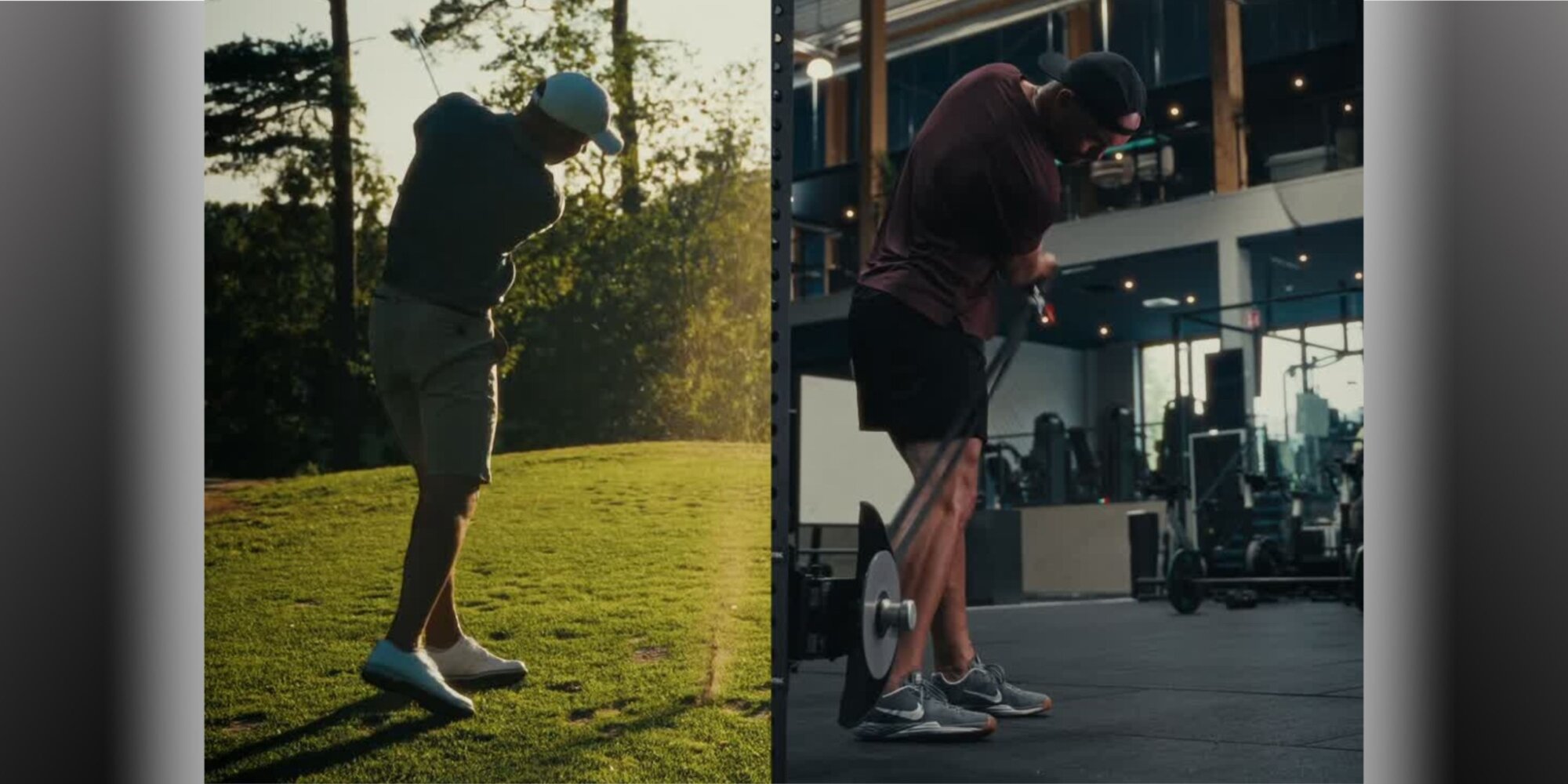
A Golfer’s Guide to Not Golfing: Off-Season Strength and Power with Flywheel Training
We’ve all been there. You make perfect contact. The ball climbs into the sky, holds a gorgeous line … and then drops painfully short of where you pictured it. Sometimes, skill can only take you so far.
Want to get more out of your flywheel training? Join our FREE Golf Webinar.
Executive summary
The off-season is where golfers can build physical qualities that are difficult to develop while playing frequently. Flywheel Training makes that work practical at home: the kBox supports squats, hinges, and unilateral leg training, while the kPulley adds horizontal and rotational loading. Variable resistance auto-regulates the load to your effort on every repetition, while the Exxentric App and kMeter can turn progress into trackable data. Begin with a strength base, transition toward power, and reduce volume as the season approaches so more energy can go into swing speed, timing, and skill.
You know the shot. The contact is pure. The ball launches from the face, climbs through the air, and seems like it’ll carry forever. Then gravity wins.
The instinct is to search for another swing cue. Shift the hips. Turn harder. Release sooner. But sometimes the missing piece is not another technical thought. Sometimes skill can only take you so far, and the body needs more force to give that skill somewhere to go.
You can see the same realization across modern golf. Players are getting visibly stronger and taking physical preparation more seriously. It is probably not a coincidence that your favorite golfer has added a shirt size and picked up a protein powder sponsorship. The trend is difficult to miss: speed and strength now have a clear place in the modern game.
As a golfer, I want the same thing many players want: more speed without losing control, more distance without forcing the swing, and enough strength to keep producing late in a round. The off-season gives us time to build that capacity without trying to cram it in between tee times.
That is the opportunity behind off-season Flywheel Training for golf. You can train the legs that drive against the ground, the trunk that transfers force, and the upper body that guides it through the club, all before you step back onto the course.
A useful runway for progressive off-season training
A faster swing starts below the belt
The golf swing is a coordinated whole-body action, not an arm-dominant hit. Research in experienced golfers found that total work performed by the hips, knees, and ankles during the downswing was strongly associated with clubhead velocity. A 2024 systematic review also reported meaningful associations between clubhead speed and lower-body strength, jumping power, and upper-body explosive strength.
Association is not causation, and more gym strength does not automatically create a better swing. Technique determines how effectively a golfer organizes and transfers force. But the evidence supports a useful conclusion: stronger, more powerful physical qualities give the golfer more capacity to work with.
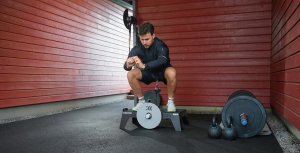
That makes the legs the logical starting point. Squats, split squats, lateral squats, and Romanian deadlifts can build the force base beneath the swing while challenging the golfer to stay balanced through force production and force absorption.
Variable resistance meets you at your effort
On an Exxentric system, you accelerate the flywheel and then control the energy that returns. Resistance is created by your effort and the selected inertia rather than by lifting a fixed stack against gravity.
In practical terms, the load auto-regulates for you from rep to rep. Push harder and more energy returns. Ease off and the demand adjusts immediately. Selected inertia still shapes the character of the exercise, but the resistance follows the effort you can produce in that moment. That makes the same movement usable for controlled strength work, faster power-focused repetitions, and carefully scaled loading when a qualified clinician has included the exercise in rehabilitation.
Rotational power is transferred, not isolated
The swing rotates, but training rotation is not simply a matter of twisting harder. Power begins with pressure against the ground, moves through the hips and trunk, and continues through the shoulders, arms, and club. Every part has to contribute in sequence.
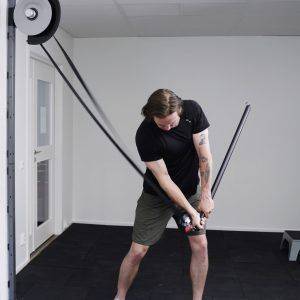
The kPulley, especially with the Rotational Sling or Double Grip Bar, can load that connection from a stable stance. Rotational sling turns, standing wood chops, single-arm rows, and presses let the golfer create and control force through different angles.
These are not loaded golf swings. They are strength exercises for the physical links the swing depends on. Keep technical swing practice with a golf coach; use the gym to improve the capacity behind it.
Build capacity first, then express it faster
The most common off-season mistake is trying to train everything at once. Heavy strength work, maximal-speed swings, high-volume practice, and conditioning all compete for recovery when they are layered without priorities.
A better plan changes emphasis over time. Establish strength and movement control first. Then retain that base while increasing movement speed. As the season approaches, lower the gym volume and give more space to swing speed, timing, and ball striking.
The physical qualities behind a more powerful drive
The strongest program connects every exercise to a clear job in the swing.
Phase 1: build the off-season strength base
Use the first four to six weeks to learn the system and establish repeatable movement quality. Select manageable inertia, accelerate smoothly, and control the return without being pulled out of position.
The kBox should do much of the lower-body work. Squats and Romanian deadlifts build bilateral strength. Split squats and lateral squats develop single-leg capacity and control across the frontal plane. On the kPulley, rows, presses, and controlled rotations build the trunk and upper-body connections around the swing.
Two sessions per week is a useful starting point for many golfers. Keep at least one day between demanding sessions, and progress one variable at a time: execution, range, effort, inertia, sets, or repetitions.
Phase 2: turn strength into usable power
After the base phase, keep the important strength movements but reduce the amount of slow, fatiguing work. Add faster concentric intent with an inertia you can accelerate aggressively while still controlling the return.
This phase might combine a strength-focused kBox squat or split squat with faster squat variations, rotational sling turns, standing wood chops, or high pulls. The goal is not to make every exercise look like golf. It is to teach the stronger body to produce force quickly while maintaining position.
Research comparing resistance-training methods in golfers suggests that combined general and golf-specific work may improve clubhead speed and hitting distance more than general strength work alone. That supports a clear division of labor: use Flywheel Training to develop strength and power, then pair it with coached speed work and high-quality swing practice.
Phase 3: arrive fresh enough to use it
In the final two to three weeks before regular play, shift the priority toward skill and power expression. Maintain intensity, but trim total gym volume. One or two short sessions can preserve the strength signal without carrying unnecessary soreness or fatigue into speed practice.
Keep a small number of productive movements, perform fewer total sets, and protect the quality of every repetition. The goal is no longer to accumulate work. It is to retain what you built while giving the swing more room to become fast, coordinated, and repeatable.
How off-season Flywheel Training for golf should progress
The following example is a framework, not an individual prescription. Training age, injury history, playing schedule, and access to coaching should shape the final plan.
Weeks 1-4: strength base
- kBox squat: 3 sets of 6-8 controlled repetitions.
- kBox Romanian deadlift: 3 sets of 6-8 repetitions.
- kBox split squat: 2-3 sets of 5-8 repetitions per side.
- kPulley row or press: 2-3 sets of 6-10 repetitions per side.
Weeks 5-7: strength-to-power transition
- kBox squat: 2-3 sets of 5-6 forceful repetitions.
- kBox split squat or lateral squat: 2-3 sets of 5-6 repetitions per side.
- kPulley Rotational Sling rotation: 3 sets of 5-6 repetitions per side.
- kPulley standing wood chop or high pull: 2-3 sets of 5-8 fast, controlled repetitions.
Weeks 8-10: power expression and maintenance
- Choose one lower-body strength movement: 2 sets of 4-6 repetitions.
- Choose one faster lower-body movement: 2-3 sets of 4-6 repetitions.
- Choose one rotation and one pull or press: 2 sets of 4-6 repetitions per side.
- Place speed swings or technical practice after adequate recovery, not after a fatiguing session.
Begin each block below maximal effort while learning the movement. Stop when speed or control deteriorates. Use the Exxentric App and kMeter where available to monitor output, but let consistent technique determine whether the load is appropriate.
PAP, PAPE, and the search for a faster first swing
Golfers often use the term post-activation potentiation, or PAP, for a heavy or forceful activity performed before an explosive action. In practical sport settings, post-activation performance enhancement, or PAPE, is usually the more accurate term. It describes a possible short-term improvement in performance after a conditioning activity and recovery period.
Recent flywheel research found a small acute improvement in jump performance, particularly after eight to twelve minutes of recovery, but no clear sprint benefit. That evidence is not golf-specific. It does not prove that flywheel squats or rotations will immediately increase clubhead speed.
Treat PAPE as something to test, not assume. An experienced golfer could compare a familiar warm-up with and without a brief flywheel conditioning activity, then track clubhead speed, strike quality, and perceived readiness. If speed rises without disrupting rhythm or accuracy, it may earn a place in the pre-round routine. If it creates fatigue, it has missed the point.
Rehabilitation needs progression, not improvisation
The off-season is also when many golfers address the knee, hip, back, elbow, or shoulder issues that accumulated during play. Exxentric systems can scale effort and support controlled concentric and eccentric work across many movement patterns. Research in late-stage ACL rehabilitation provides one example of flywheel loading being investigated inside a supervised program.
That does not make a general golf program a rehabilitation plan. Injury type, tissue status, range, load, and return-to-sport criteria require individual clinical judgment. If pain or injury is part of the off-season, use the kBox or kPulley only within guidance from a qualified clinician and coordinate the progression with the golf coach.
The home advantage is consistency you can measure
The best off-season plan is the one that survives dark mornings, poor weather, and a full calendar. A compact Exxentric setup removes the drive to the gym and the need for a room filled with racks, plates, and cable stations.
The kBox covers the foundational leg work in a small training area. The kPulley expands the setup into horizontal, upper-body, and rotational movements. Because the resistance responds to effort, the same systems can support the controlled work of the base phase, faster repetitions in the power phase, and shorter maintenance sessions close to the season.
Add the Exxentric App and kMeter, and that convenient home training becomes measurable. Rep-level feedback helps you monitor power, see when output begins to fall, and compare progress across an off-season block. The data cannot diagnose a swing or replace ball-flight feedback, but it can show whether the physical work is moving in the intended direction.
That combination of access and feedback matters more than it sounds. Twenty focused minutes at home, repeated and tracked every week, will usually do more for a golfer than the perfect program that is too inconvenient to complete.
Why kBox and kPulley work together for golfers
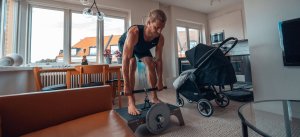
The kBox gives golfers a compact platform for squats, hinges, split-stance work, and lower-body force development. The kPulley adds adjustable horizontal loading for rotation, pulls, presses, and hip-focused movements.
Together, they cover the physical chain from the ground to the hands. The point is not to recreate the golf swing under maximum resistance. It is to build stronger links, teach them to produce and absorb force, and then let golf practice organize that capacity into a skilled swing.
Off-Season Performance Summary
|
Training Phase
|
Flywheel Focus
|
Golf Priority
|
|---|---|---|
|
Strength Base
Weeks 1-4
|
Controlled force
Legs, hips, trunk
|
Build capacity
Limit hard speed work
|
|
Strength to Power
Weeks 5-7
|
Faster intent
Maintain control
|
Add speed practice
Coordinate new capacity
|
|
Power Expression
Weeks 8-10
|
Low volume
High-quality output
|
Skill takes priority
Arrive fresh
|
|
In-Season Entry
First playing block
|
Maintenance dose
Short and consistent
|
Protect performance
Fit around play
|
Movement examples
Explore lower-body and rotational exercise options, then select a small number that match the goal of the current training phase.
The bottom line
You do not need a course to begin improving the physical side of your golf game.
Use the early off-season to become stronger. Turn that strength into faster, more coordinated power as the season approaches. Then reduce the training volume enough to let your swing use what your body has built. Off-season Flywheel Training for golf will not select the right club, read the green, or replace technical practice. It can help you arrive at the first tee with more physical capacity behind every shot.
Key takeaways
- Lower-body strength and explosive qualities are associated with clubhead speed, but technique determines how force is transferred into the club.
- The kBox supports foundational leg strength through squats, hinges, split squats, and lateral patterns.
- The kPulley adds rotational, pulling, pressing, and hip-focused training from adjustable angles.
- Variable resistance auto-regulates load to the effort produced on each repetition, making one setup useful across strength, power, maintenance, and appropriately supervised rehabilitation work.
- Off-season programming should progress from a strength base toward faster power expression, with lower gym volume as golf practice increases.
- The Exxentric App and kMeter can track power trends and help guide progression across the off-season.
- PAPE may offer a short-term performance effect for some trained athletes, but golf-specific flywheel evidence is limited and individual testing is essential.
Build the body behind a more powerful swing
Explore the kBox and kPulley Advanced Combo, or talk to an Exxentric expert about a home setup for your off-season goals.
Research referencesGolf physical qualities: Brennan, A., et al. (2024). Associations Between Physical Characteristics and Golf Clubhead Speed: A Systematic Review with Meta-Analysis. Sports Medicine, 54(6), 1553-1577. DOI: 10.1007/s40279-024-02004-5. This review found associations between clubhead speed and several strength and explosive qualities; associations do not establish that improving any single test will directly increase clubhead speed.
Resistance training and golf performance: Uthoff, A., Sommerfield, L. M., & Pichardo, A. W. (2021). Effects of Resistance Training Methods on Golf Clubhead Speed and Hitting Distance: A Systematic Review. Journal of Strength and Conditioning Research, 35(9), 2651-2660. DOI: 10.1519/JSC.0000000000004085. The review supports resistance training for clubhead speed and distance, especially when general and golf-specific work are combined; it does not isolate Flywheel Training.
Flywheel strength and power: Petré, H., Wernstål, F., & Mattsson, C. M. (2018). Effects of Flywheel Training on Strength-Related Variables: a Meta-analysis. Sports Medicine – Open, 4, 55. DOI: 10.1186/s40798-018-0169-5. This review supports flywheel-related gains in strength and power across healthy and athletic populations; it is adjacent evidence rather than golf-specific proof.
Flywheel periodization: Hu, Z., et al. (2024). Comparing the Effect of Isoinertial Flywheel Training and Traditional Resistance Training on Maximal Strength and Muscle Power in Healthy People: A Systematic Review and Meta-Analysis. Life, 14(7), 908. DOI: 10.3390/life14070908. Flywheel Training was not superior to traditional resistance training for maximal strength, but the pooled analysis favored it for muscle power; protocols and participants varied.
Acute PAPE response: Zhang, R., et al. (2026). Acute effects of flywheel resistance training on jump and sprint performance: a systematic review and meta-analysis of inertial-load and rest-interval moderators. BMC Sports Science, Medicine and Rehabilitation, 18, 236. DOI: 10.1186/s13102-026-01553-8. The review found a small acute jump effect but no significant sprint effect, with low certainty and no direct golf outcome.
Rehabilitation context: Stojanović, M. D. M., et al. (2023). Effects of Eccentric-Oriented Strength Training on Return to Sport Criteria in Late-Stage Anterior Cruciate Ligament (ACL)-Reconstructed Professional Team Sport Players. Medicina, 59(6), 1111. DOI: 10.3390/medicina59061111. This supervised late-stage ACL study involved professional team-sport athletes, not golfers, and should not be generalized into a self-directed rehabilitation protocol.
Evidence note: Golf research directly supports relationships between physical qualities, resistance training, clubhead speed, and driving distance. Flywheel research supports strength and power development in broader populations. The specific golf applications, phase structure, and PAPE suggestions in this article are evidence-informed programming rationale rather than proof that an Exxentric program will add a fixed number of yards or lower a handicap.
Credited author: Stephen Badenhorst, Exxentric.