


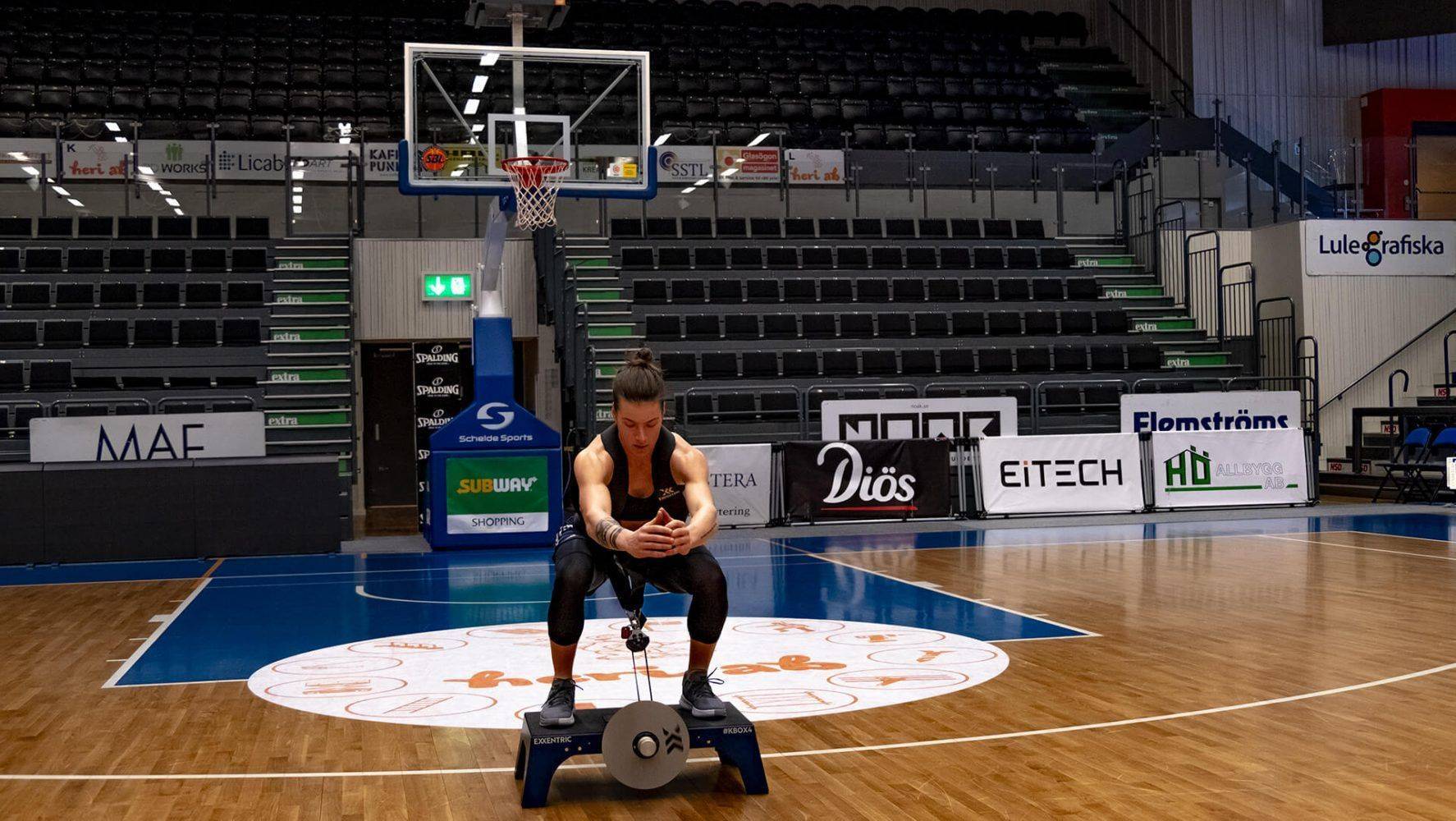
Using Flywheel Equipment for PAP and PAPE Before Competition
This approach is often referred to as post-activation potentiation (PAP), although the improvement in athletic performance itself is more accurately described as post-activation performance enhancement (PAPE).
PAP refers to a temporary increase in muscle twitch force following activation. PAPE describes improved voluntary performance following a conditioning activity and a period of recovery. The two phenomena are related, but distinct.
A conditioning stimulus can be used before jumping, kicking, cutting, sprinting and other explosive athletic actions. One typical routine for jumping is to perform heavy squats before the movement. Fatigue will also be created, however, so the aim is to allow sufficient recovery for the potential performance enhancement to emerge.
Finding the Right Stimulus and Recovery Time
The balance between the conditioning stimulus and the fatigue it creates is why the procedure needs to be individually adapted.
The same stimulus could be sufficient for one athlete to achieve a performance enhancement but create too much fatigue for someone else. Hence, both the stimulus and the resting time before the athletic action need to be individualized.
Some athletes need to do more work to achieve the desired response, while others might need longer recovery from fatigue.
You can also see the response to a specific stimulus changing after a training period. The procedure therefore needs to be adapted not only between athletes but also according to training level, fatigue and other factors within the same individual.
Why Use Flywheel Equipment for PAP and PAPE?
The kBox can be a useful tool for performance priming, with several practical advantages compared with traditional weights.
Flywheel exercise provides high muscular activation and allows athletes to generate substantial force during both the concentric and eccentric phases. This can provide a demanding conditioning stimulus before subsequent explosive actions.
For example, in swimming, one study showed that athletes achieved 35% higher mean horizontal flight velocity during swimming starts following a flywheel lunge protocol compared with a standard warm-up.
Another study by Beato et al. (2020) investigated the use of flywheel exercise with eccentric overload as a conditioning stimulus.
In addition, the kBox is mobile and can be used almost anywhere, including a locker room or on the pitch. Resistance is variable, so a simple setup can accommodate a demanding stimulus for a wide range of athletes in a team.
The straightforward setup is also beneficial when cycling through multiple athletes during a short period of time. Optional kMeter feedback provides real-time data, allowing coaches to monitor conditioning output and make the stimulus more repeatable.
Using Flywheel Equipment Before Competition
Research has explored flywheel conditioning protocols using a wide range of inertias. In general, the same principles of balancing stimulus, fatigue and recovery apply as with traditional weights. Isometric training methods are another possible approach to creating a potentiating stimulus.
Remember to test the procedure in training before using it in competition. It is important to find an appropriate:
- Exercise to prepare for the action you want to perform.
- Stimulus, including inertia, sets, repetitions and intensity.
- Resting time between the conditioning stimulus and the performance task.
There is no simple recipe here. Focus on the overall goal: appropriate exercise, stimulus and rest.
A recovery period of 3–6 minutes and three sets of the conditioning action have been suggested as practical starting points. However, these should not be treated as universal prescriptions.
Flywheel exercise can be very intense and demanding, and you are probably better off doing too little than too much. Test and adjust the protocol in training before the next competition.
Familiarization Is Important
Experience with flywheel equipment is important. At least four or five familiarization sessions before using it in competition have been recommended.
First, the athlete needs to understand how to use the kBox, learn the flow of the exercise and find the rhythm. This builds confidence to work hard on the device and contract the intended muscles.
Familiarization is also an important factor in building resilience to the workload and minimizing the fatigue component.
During this process, coaches can measure performance to adjust and individualize the stimulus and resting time for the best possible effect.
Summary
Before athletic movements that demand high performance in sprinting, jumping, kicking or swimming, an appropriate conditioning stimulus may help improve subsequent performance.
This can be achieved using flywheel equipment such as the kBox. In general, the same principles apply as with traditional weights: familiarize your athletes with the equipment, adapt the protocol individually and recalibrate during different training periods.
For an overview of the underlying concepts and their application with kBox, see our PAP and PAPE page.
For a more detailed example of testing recovery intervals, see Jump Performance: Testing the Rest Window.

Fredrik Correa
MD, CEO & Co-Founder, Exxentric
