Baseball Power Starts Before the Swing
The 2026 World Series begins on 23 October. By then, every team still standing will have spent a long season turning small advantages into playable ones: a better at-bat, a cleaner throw, one more controlled stop on a difficult play. The moment on television looks rotational. The preparation behind it is broader.
For baseball coaches, the useful question is not whether rotation matters. It is where rotation sits in the chain that produces a swing or throw, and which part of that chain the current training environment is failing to develop.
The World Series makes one movement easy to miss
Baseball is full of visible rotation. A hitter turns into the ball. A pitcher separates the pelvis and trunk before release. A fielder plants, redirects and throws across the diamond. Those actions can make a rotational exercise look like the obvious answer.
The harder job is deciding what the rotation needs around it. Force has to come from the ground, travel through the lower body and trunk, reach the arm or bat and then be controlled as the movement ends. A programme that only chases a faster twist can miss the lower-body strength or braking capacity that lets the twist happen repeatedly.
That is why a sport-specific movement should be treated as a training question, not a product category. Which link is limiting the athlete today? Is the need foundational lower-body force, the ability to produce and control force in the horizontal plane or a reliable way to compare like-for-like output over time?
What the newest swing-speed study can and cannot tell coaches
A 2026 study of 96 male youth baseball players examined whether common power tests could explain bat-swing speed. The players performed standardized tee swings, medicine-ball throws and countermovement jumps. In the authors’ model, medicine-ball power was strongly associated with swing speed, with rotational and backward overhead throws showing the strongest contributions. Lower-body power did not directly predict swing speed in the model, but it showed an indirect relationship through medicine-ball power.
That is useful evidence for keeping the whole chain in view. It is not a prescription for professional hitters, and it does not show that adding one exercise will make an athlete swing faster. The study was cross-sectional, used youth players and measured associations rather than a training intervention. It also tells us about tests and relationships, not about Flywheel Training specifically.
The practical reading is modest: coaches can assess more than the final movement. A swing-speed result may be worth viewing alongside lower-body and whole-body power measures, then interpreted with the athlete’s skill, training history and role. A strong test result does not replace hitting or throwing work. It can help identify which physical quality deserves attention next.
Where Flywheel Training fits
Flywheel resistance gives the athlete two related jobs in one repetition. The user accelerates the flywheel during the concentric phase, then controls the energy returning during the eccentric phase. A harder acceleration stores more energy, so the return phase demands more control. The device does not decide the effort or guarantee an eccentric overload; the exercise, inertia, intent and braking strategy shape the demand.
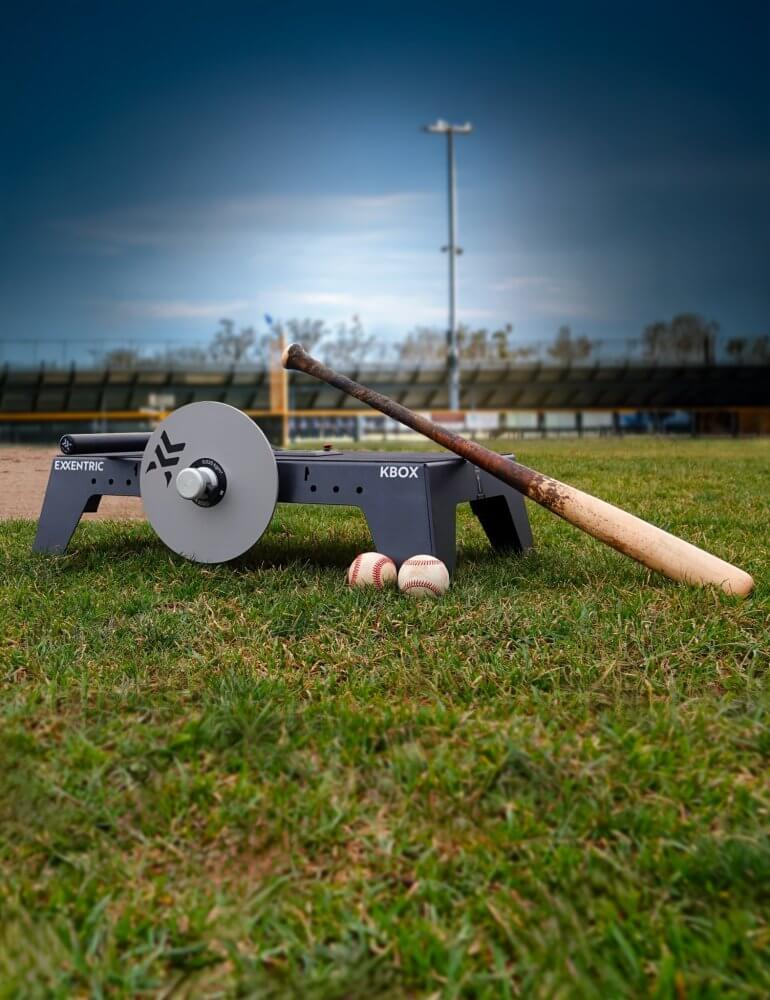
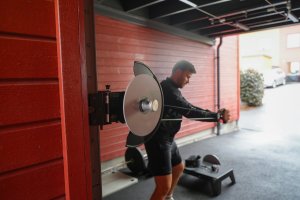
That mechanism can suit baseball training when the goal is to connect force production with force control. A platform-based Exxentric kBox can support the lower-body and full-body work that gives rotation a base. A kPulley can add adjustable-angle pulling, pressing and rotational patterns for coaches who need a horizontal-plane option. Those are equipment capabilities, not evidence that a particular exercise will transfer automatically to bat speed or throwing velocity.
Measurement can help when it changes a decision. With compatible kMeter hardware and the Exxentric App, a coach can compare like-for-like repetitions or sessions and review output over time. The kMeter is not a swing-speed test or a medical assessment, and comparisons only make sense when exercise, setup, inertia, range and technique are sufficiently consistent.
Two training jobs, one decision
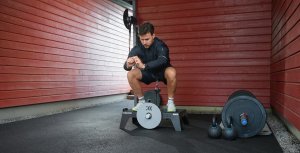
The useful setup depends on the gap in the programme. If the missing job is foundational strength, the coach may need a platform that can organise squats, hinges, rows and other full-body patterns. If the missing job is force through different angles, a pulley system may make it easier to load pulling and rotational movements in the horizontal plane. Many performance environments will use both kinds of work, while keeping skill practice and throwing load in their own lane.
A number is useful when it helps decide whether to repeat, progress or change a training task; it is noise when it is collected without a decision attached.
The question to take into the next training block
October baseball puts the final movement on display, but the next training block should start earlier in the chain. Look at the athlete’s role, the movement quality that is missing and the physical quality that can be trained without competing with skill work. Then choose the smallest set of exercises and measurements that can answer that question clearly.
Flywheel Training can be one part of that process. Its value for baseball is the combination of effort-responsive resistance, full-body options and the ability to load force production and control in more than one direction. The result still depends on the athlete, the exercise, the programme and the decision the coach is trying to make.
Build the part that lets the swing arrive
The World Series is decided by moments, but those moments are supported by a chain of physical qualities. Rotational power belongs in that chain. So do the legs, the trunk, the ability to brake and the discipline to measure only what can guide the next choice.
Explore Exxentric’s baseball Flywheel Training application and compare the movement options with the problem your programme needs to solve.
Explore Baseball Flywheel Training
See how Exxentric equipment can support baseball-specific strength and rotational work.
MLB: Major League Baseball. (2026). 2026 MLB playoff and World Series schedule.Study: Park HS, Song KJ, Lim YE, Kim JY, Yoon JH. (2026). Identification of key power predictors of bat swing speed in youth baseball hitters: Implications for training design. Journal of Strength and Conditioning Research. DOI: 10.1519/JSC.0000000000005599. Cross-sectional study of 96 male youth players; associations do not establish that a training intervention or Flywheel Training will increase swing speed.