The Best All-in-One Training System for a Home Gym
You gain a cable station, but lose floor space. You get adjustable resistance, but sacrifice heavy loading. You buy a machine that promises hundreds of exercises, then discover that most of them are variations of the same movement.
The best all-in-one training system should do more than offer a long exercise list. It should provide useful resistance across different movements, suit more than one type of user, occupy a reasonable footprint and remain dependable long after the novelty wears off.
Start with the resistance, not the exercise count
An all-in-one machine can use weights, rods, cables, air, motors, coils or flywheels. Each option changes how the resistance behaves, where it feels hardest and what kind of training it supports.
The right choice depends on what you want from your home gym. Strength? Power? Muscle growth? Conditioning? Multiple users? A compact footprint? Facility-level durability?
The more demanding the brief, the less useful a simple exercise-count comparison becomes.
Weighted multi-gyms: familiar, capable and difficult to ignore
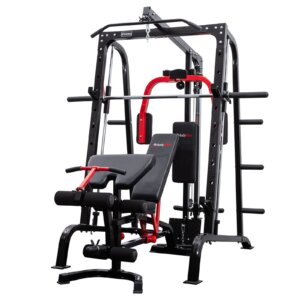
Traditional multi-gyms use weight stacks or plates connected to several stations. They remain popular because they are easy to understand. Select a load, sit or stand in the machine and move through a guided path.
For general strength training, this can work well. A weight stack provides predictable loading and a multi-gym can include pressing, pulling, leg extension, leg curl and other exercises in one structure.
The compromise is scale.
Even relatively compact weighted multi-gyms are substantial pieces of equipment. They are difficult to move, often require a permanent location and can make a home gym feel more like a commercial training room. The fixed stations also limit how freely the user can move.
A multi-gym can be an excellent solution when the priority is guided resistance across familiar exercises. It is less convincing when the goal is one compact system that can adapt to different users, movement patterns and training environments.
Bowflex-style devices: convenient resistance with a softer ceiling
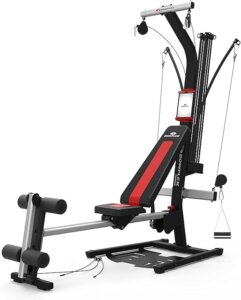
Bowflex-type systems use flexible rods or similar elastic resistance elements. Their appeal is obvious: they can provide several exercises without the same amount of metal and weight associated with a conventional multi-gym.
They are also approachable. The resistance is often smooth, the setup is relatively simple and the equipment can suit people who want a broad range of general fitness exercises at home.
The limitation is how the resistance behaves.
Elastic resistance increases as the material stretches, which can create a very different loading profile from free weights or inertia. That may be useful for some movements, but it can feel less natural when the goal is heavy strength work through a full range of motion. The maximum resistance is also determined by the rods or bands available in the system.
Bowflex-style equipment is a practical choice for convenience and general training. It is harder to justify when high resistance, athletic movement and long-term adaptability are central requirements.
Cable stacks: the versatile classic
Cable stacks are perhaps the most recognisable all-in-one strength solution. With the right pulleys, handles and adjustable positions, one station can support rows, presses, pulldowns, curls, triceps work, rotations and many lower-body exercises.
The cable is flexible because the user can change the angle and attachment. A pulley ratio can also make the resistance feel lighter or heavier, depending on the configuration.
But cables still need a structure. A serious cable station takes up vertical and horizontal space, and the surrounding frame can restrict where exercises happen. The weight stack creates a clear upper limit, while multiple users may need to wait for the same station.
Cable stacks are hard to beat for familiar upper-body training and controlled resistance. They are less efficient when one compact system needs to cover heavy lower-body work, explosive intent and eccentric loading as well.
Air resistance: excellent for output, different for strength
Air resistance machines use a fan to create drag. The harder the user works, the more air the fan moves and the greater the resistance becomes.
This is why air resistance works so well for rowers, ski ergs and air bikes. It scales naturally with effort, supports repeatable intervals and makes high-volume conditioning straightforward.
Air resistance has also moved into strength-focused equipment. Devices such as the Rogue Air Rhino and Concept2 StrengthErg show how fan-based resistance can be used for pressing, pulling and other strength patterns.
The important distinction is mechanical. Air resistance dissipates energy through airflow. A true isoinertial flywheel stores energy during the concentric phase and returns it during the eccentric phase.
That makes air resistance useful for conditioning, strength endurance and concentric-focused output. It is less suited to someone looking for a system that also creates a meaningful eccentric demand. As explained in Flywheel Training versus air resistance, a spinning fan is not the same thing as a solid-disc flywheel.
Electric resistance: intelligent and increasingly sophisticated
Motorised systems use electric resistance to create programmable loads. They can offer digital weight selection, changing resistance profiles, feedback and guided workouts.
This is an attractive proposition for home users who value coaching, data and a polished user experience. An electric system can also change resistance quickly between users and exercises without requiring plates or a weight stack.
The trade-off is complexity.
Motors, screens, software and connected services introduce more components that may require updates, support or replacement. The training experience can also depend on the system’s software and the resistance profiles it provides. What feels highly flexible in one exercise may feel more constrained in another.
Electric resistance is compelling when digital guidance is the priority. It is less appealing when reliability, independence from software and physically adaptable resistance matter most.
Coil resistance: simple, compact and limited by its spring
Coil-based systems use springs or torsion elements to create resistance. They can be compact, relatively light and quick to adjust, making them attractive for smaller home gyms.
The resistance typically increases as the coil is loaded or rotated. That can produce a smooth experience and support a range of upper- and lower-body movements.
As with rods and bands, the challenge is the resistance curve. The system may feel very different at the beginning and end of a movement, and the available load is tied to the coils included. It can be a smart solution for compact general fitness, but it does not offer the same resistance ceiling or loading flexibility as a system built around interchangeable weights or flywheels.
Flywheel resistance: the all-in-one system that behaves like more than one machine
Flywheel resistance takes a different approach.
Instead of lifting a fixed mass or stretching a spring, the user accelerates a rotating flywheel. The harder they push or pull, the more kinetic energy they store. When the strap rewinds, that energy returns and the user must control it.
That creates a closed-loop resistance system with both concentric and eccentric demands in the same repetition. Eccentric overload is possible with suitable execution and programming, but it is not automatic.
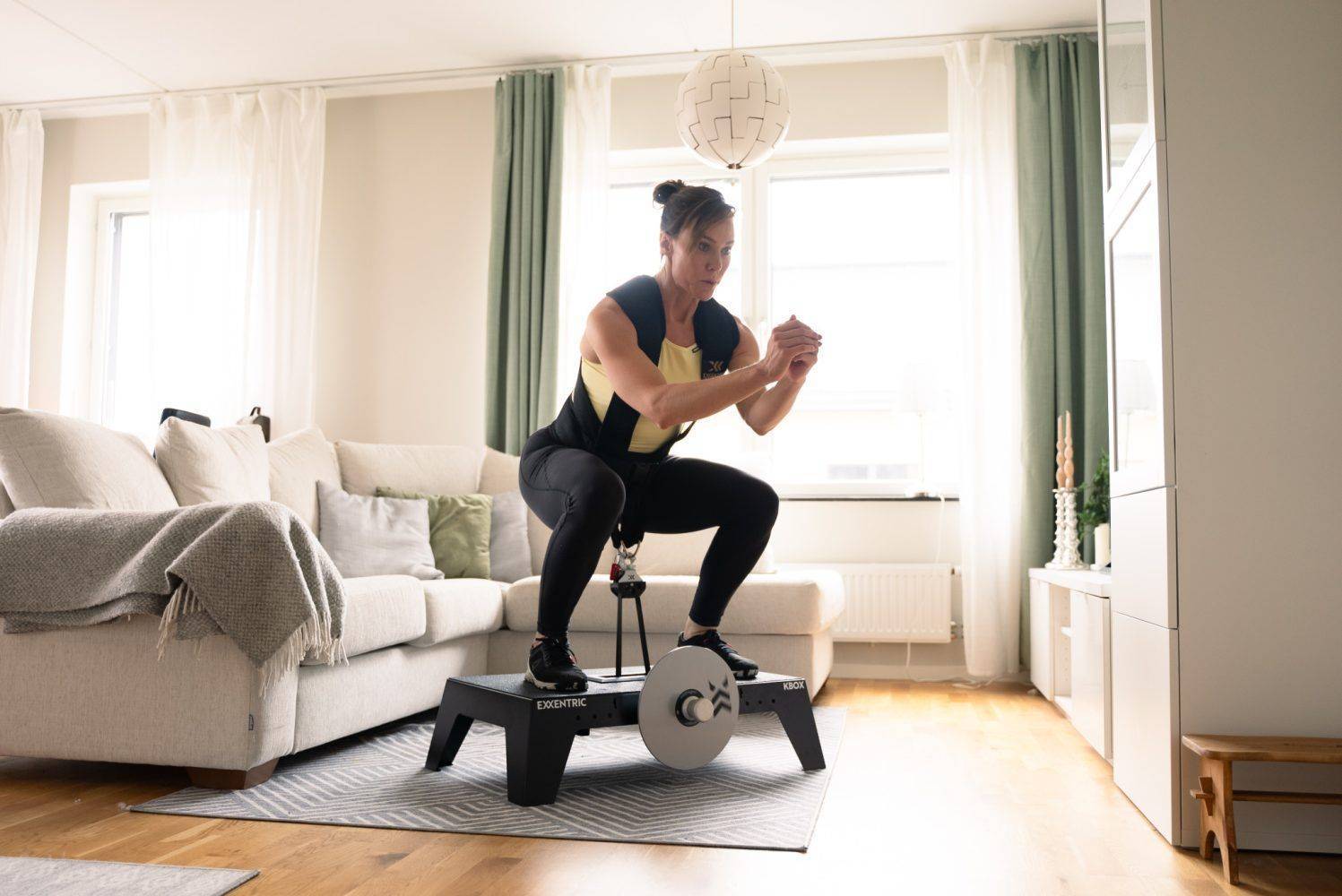
For an all-in-one system, this matters because the resistance is not tied to one fixed movement path. A kBox can support squats, hinges, lunges, rows, pulls, rotational work and other upper- and lower-body patterns by changing the attachment or setup.
The kBox also occupies a small footprint. The kBox Lite and Active measure approximately 81 by 51 centimetres, while the larger kBox Pro measures approximately 98 by 63 centimetres. The platforms can use different flywheel sizes to adjust inertia across a broad range, from 0.005 to 0.280 kgm² on the standard kBox systems.
Inertia is not the same as kilograms, so it should not be treated as a direct weight-stack conversion. The actual training demand also depends on the exercise, leverage, range of motion, technique and braking strategy.
What the kBox does offer is a high resistance ceiling in a compact format, adjustable loading without a large plate collection and a resistance mechanism that supports strength, power and eccentric control. The kBox Advanced System can be configured with handles, a bar, hip belts, ankle cuffs, a harness and other attachments. Compatible models can also provide performance feedback through the kMeter system.
That combination is difficult for any single conventional machine to match.
A few examples in the real world
A weighted multi-gym from brands such as Body-Solid or Inspire may suit someone who wants guided, station-based strength training.
A Bowflex-style system may suit a home user who values compact storage and straightforward general fitness.
A cable stack from brands such as Life Fitness or Technogym can be an excellent choice for a facility built around familiar cable exercises.
An air-resistance option such as a Rogue Air Rhino or Concept2 StrengthErg may be the right tool when repeatable output, conditioning and concentric power are the priority.
A motorised system such as Tonal can appeal to users who want digital coaching and programmable resistance.
The best all-in-one system is the one that keeps expanding
The kBox is not the best choice because it imitates every other machine. It earns that position because it brings together the qualities that usually force people to choose between systems: compactness, high resistance potential, movement variety, portability, measurable training and a durable mechanical design.
For users who need more cable-based pressing, pulling and rotational work, combining it with a kPulley can extend the setup further. But as a single piece of all-in-one equipment, the kBox offers the most convincing balance of versatility, resistance and space efficiency available for a home gym or smaller training facility.