Apartment Gym Equipment That Fits Your Space and Schedule
Free Harness with the kBox Active System
Order the kBox Active System through Friday, September 25, 2026, and receive a Harness at no additional cost. The Harness supports squats, lunges, split squats, lateral squats, and calf work while keeping the hands free.
Executive summary
Apartment gym equipment has to work around shared floors, lease restrictions, limited training time, and rooms with more than one purpose. The kBox Active System brings full-body resistance and conditioning to an 81 x 51 cm platform, while kPulley systems add horizontal and rotational options where secure mounting is possible. Flywheel resistance creates demanding work without a large inventory of loose weights.
Most home gyms begin by losing an argument with the room. A rack takes one wall. Plates spread across the floor. A bench becomes permanent furniture. Then a bike or rower claims whatever space is left.
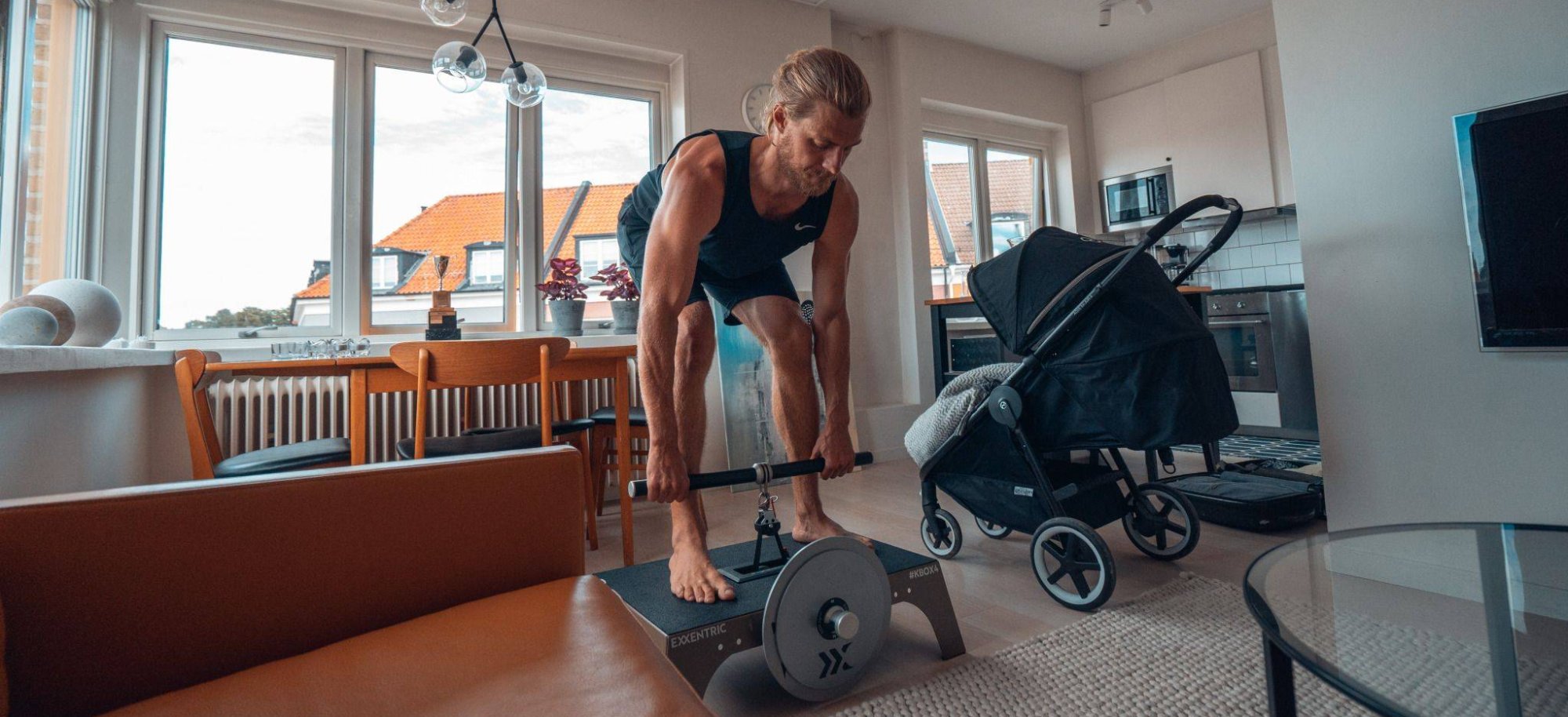
An apartment needs a different question: how many useful training jobs can one system perform without requiring a dedicated room? On the kBox, that can include squats, hinges, lunges, rows, presses, pulls, curls, and conditioning work. The space remains a home first; training uses it when needed.
That is the practical case for flywheel equipment in an apartment. It reduces the infrastructure around the workout, not the ambition inside it.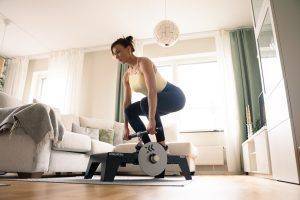
Adaptive-resistance exercise possibilities
Apartment gym equipment has to earn its floor space
Commercial gyms can dedicate separate zones to racks, machines, free weights, and cardio. Apartments cannot. Equipment has to justify the area it occupies by doing more than one thing, and it has to coexist with normal life when the workout is over.
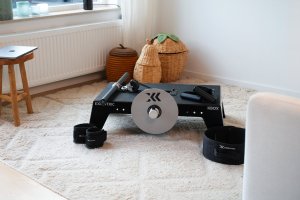
The kBox Active measures approximately 81 x 51 cm, stands 21 cm high, and weighs 16 kg. It can be used in a cleared living area without converting an extra bedroom into a gym. Its low profile, sleek black chassis, and contained flywheel design also sit more naturally in a modern interior than uprights, exposed plate stacks, and permanent cable stations.
The user still needs safe movement space and organized accessory storage. When the session ends, however, the platform can be repositioned and the room can return to its other purpose.
High resistance without a room full of weights
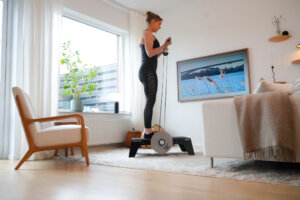
Traditional resistance equipment creates load with mass, bands, hydraulics, or pneumatics. Flywheel Training uses rotational inertia. You accelerate the flywheel during the concentric phase, and the system returns that energy during the eccentric phase.
A conventional apartment setup reaches a practical limit as training becomes heavier. More load means more plates to buy, carry upstairs, organize, and move between sets. The kBox Active approaches progression differently: selected inertia shapes how the flywheel accelerates, while the user’s effort determines how much energy enters the system.
With suitable inertia, technique, and intent, a strong user can access a demanding strength stimulus without storing an equivalent barbell load. That does not make resistance literally infinite or every flywheel exercise equivalent to a particular weight. Exercise selection, range of motion, skill, and the user’s ability still define the training demand.
Less impact risk and no dedicated lifting floor
The fear is easy to picture: a loaded bar slips, hits the floor, and the neighbor below gets more than a noise complaint. Could a dropped weight crack through an apartment floor? There is no responsible universal answer. The result depends on the building, the floor assembly, the mass, the height of the drop, and where the impact lands.
What can be said more confidently is that dropped weights can damage floor finishes or subflooring, transmit impact and vibration through the structure, injure the user, and create a serious problem with neighbors or building management. A rubber tile may protect the surface, but it does not make every building or every drop appropriate.
Flywheel resistance removes the routine need to lift and lower loose plates through open space. The resistance stays connected to the platform through the drive belt, so there is no loaded bar waiting to hit the floor.
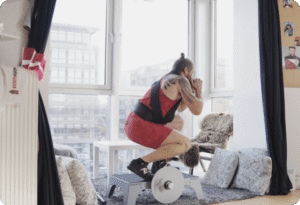
For the standard kBox movements performed with the user standing on the platform, the system is self-contained. Place it on a suitable flat, stable surface, attach the selected accessory, set the belt length, and train. A purpose-built weightlifting platform is not part of the normal setup. A perfect example is the apartment gym of long-time Exxentric Ambassador and UFC fighter, Nicolas Dalby:
Strength and cardio can share one platform
The kBox is first a resistance-training system, but the same mechanics can also make it useful for conditioning. Higher inertia and longer recovery can support strength-focused work. Lower inertia, quicker exercise transitions, and appropriately structured intervals can raise the pace and create a demanding cardiorespiratory session.
That means an apartment user can squat, hinge, row, press, and pull for strength, then use faster low-inertia work or a circuit for conditioning without moving to a second machine. The equipment stays the same; the session variables change.
This does not make every kBox workout cardio, and it does not automatically replace sport-specific endurance training, walking, running, cycling, or other aerobic work. It does mean strength and conditioning can share one system instead of requiring separate stations.
Quiet training matters when walls and floors are shared
The flywheel mechanism operates without the repeated clatter of plates or a loaded bar returning to a rack. That is a meaningful difference when another room is a few steps away and another home may be directly below.
No workout is literally noiseless: feet still contact the platform, the drive belt and accessories move, and poor technique can create unnecessary vibration. A stable surface, controlled repetitions, suitable footwear, and considerate training times still matter. The benefit is a quieter resistance mechanism, not permission to ignore the neighbours.
One system can train two very different people
Shared apartment equipment often has to work for more than one body. A fixed dumbbell set may be too light for one partner and too heavy for another. A machine with a long adjustment sequence can turn every handover into lost training time.
Flywheel resistance responds to the effort of the person using it. Two partners with different strength levels can use the same movement and inertia while each creates a different resistance demand. Belt length, accessory fit, range of motion, and technique still need to be set for each person, and changing inertia may suit different goals.
That flexibility makes partner sessions practical. One person can train while the other rests, checks technique, or prepares the next exercise. The changeover does not require unloading and rebuilding a bar between every set.
Why the kBox Active fits an apartment gym
The kBox Active System is built around the most accessible kBox platform and a selection of accessories for full-body home training. The platform supports the lower-body patterns that usually demand the most equipment: squats, deadlifts, Romanian deadlifts, lunges, split squats, and calf work.
Accessories change how the platform can be used. The Harness loads squats, lunges, split squats, lateral squats, and calf work while keeping the hands free. kGrips support rows, curls, high pulls, deadlifts, and other pulling patterns, while the kBar gives users a familiar two-handed option for deadlifts, rows, high pulls, curls, presses, and squat variations.
The kPulley systems remain relevant even when the kBox Active is the apartment starting point. A kPulley adds adjustable horizontal loading for standing rows, presses, rotations, and hip-focused movements. The kPulley Go is the most portable base option, and the kBox and kPulley Core Combo brings both movement families into one system package.
Mounting is the deciding apartment question. A kPulley needs a secure compatible mounting solution at the correct exercise height. Renters should confirm the surface, hardware, lease terms, and building permission before installation. When mounting is not practical, the freestanding kBox Active remains the simpler starting point because its core exercise library does not depend on turning a wall into a training station.
The optional kMeter connects the platform to the Exxentric App for rep-level feedback, workout guidance, and progress tracking. It gives home users a clearer way to monitor output and progression rather than relying only on feel.
The result is a setup that can start with the Active platform and expand through accessories, feedback, or a kPulley as space, goals, and installation options develop.
The bottom line
The best apartment gym is not the one that squeezes the most equipment into the room. It is the one that makes serious training practical within the space, schedule, and building rules you already have.
The kBox Active is the simplest starting point for most apartment users. Add a kPulley where secure mounting is possible, choose accessories around the movements you value, and use short sessions or partner training to make the setup work more often.
Build an apartment gym that leaves room for the apartment
Explore the kBox Active System for compact full-body strength and conditioning at home. The current free Harness promotion ends Friday, September 25, 2026. The Harness expands squat, lunge, split-squat, lateral-squat, and calf-training options from the first session.