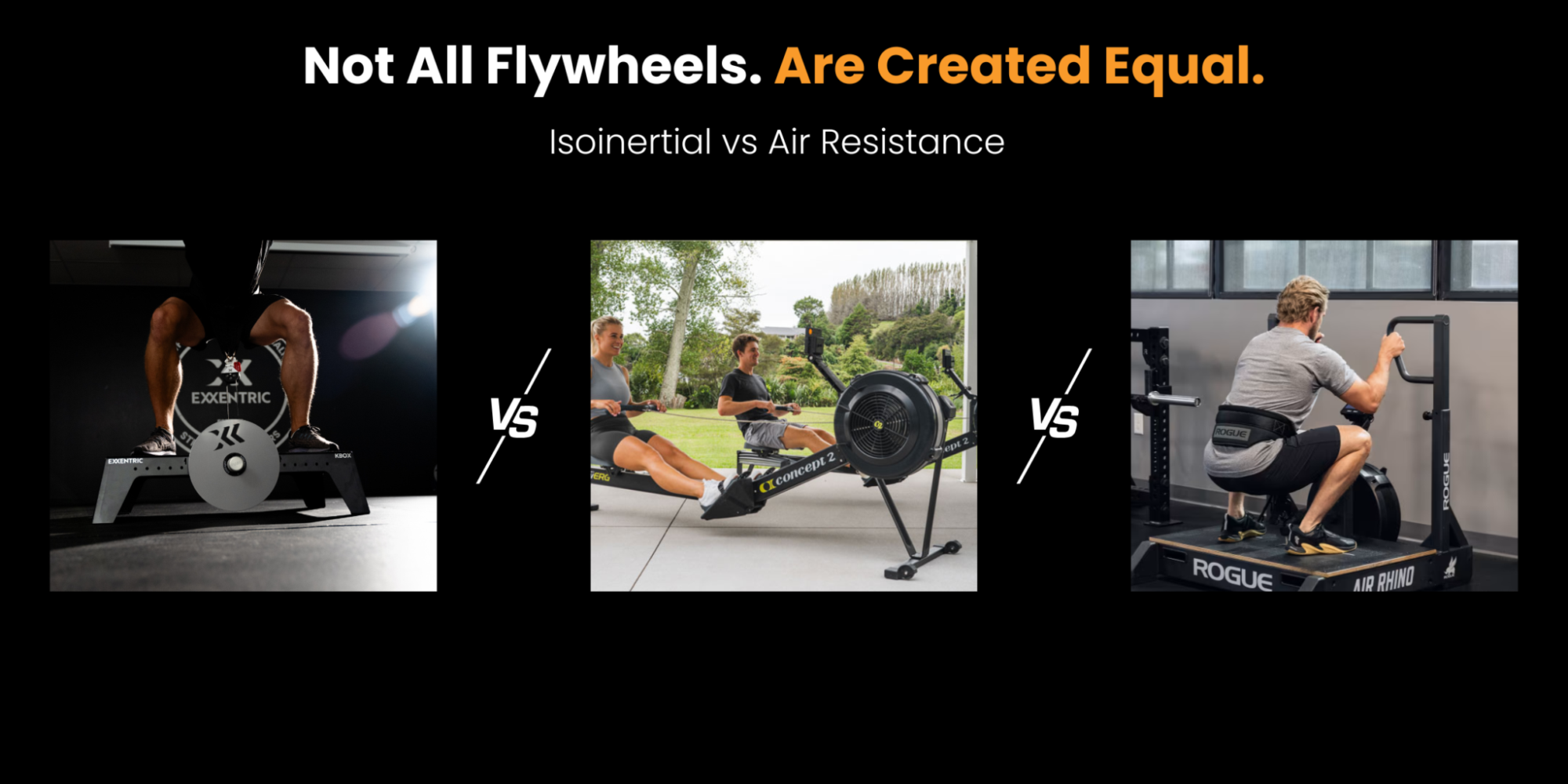
Real Isoinertial Flywheel Training vs Air Resistance “Flywheels”: Why the Difference Matters
Executive summary
Calling every fan-based resistance device a “flywheel” may be convenient, but it can blur an important training distinction. Air resistance makes excellent sense in cardio tools such as rowers, ski ergs, and air bikes because it scales naturally with effort, supports repeatable conditioning work, and keeps eccentric stress low. More recently, the same air resistance concept has moved into strength training through devices such as the Rogue Air Rhino and Concept2 StrengthErg. These tools can be useful, but they are not the same as true isoinertial flywheel systems, which store kinetic energy and return it during the eccentric phase.
A spinning fan is not the same thing as an isoinertial flywheel.
That may sound like a technical detail, but for coaches, clinicians, athletes, and facilities, it changes the training outcome. If the goal is conditioning, fan resistance can be an excellent tool. If the goal is eccentric overload, hypertrophy, strength, force absorption, or deceleration, the mechanism matters.
Over the past decade, Flywheel Resistance Training, also known as isoinertial training, has become one of the most researched strength training modalities in modern performance practice. It is used because it can challenge force production and force absorption in the same movement.
The problem is that the word “flywheel” is now being stretched across equipment categories that do not deliver the same stimulus. Rowers, ski ergs, air bikes, and newer air-based strength devices may all use a rotating fan mechanism. But that does not make them equivalent to a solid-disc isoinertial system.
Why air resistance works so well for cardio equipment
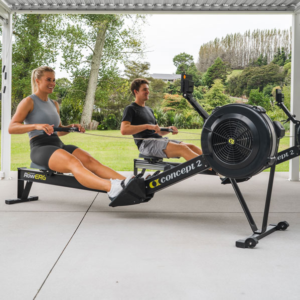
Air resistance has a clear and valuable place in training. In cardio devices such as rowing machines, ski ergs, and air bikes, fan resistance works extremely well because it is simple, responsive, and self-regulating.
The harder the user rows, skis, pedals, pushes, or pulls, the more air the fan has to move. Resistance rises with effort. That makes the experience intuitive: output increases, resistance increases, and the athlete can pace the work across intervals, endurance sessions, or repeated high-intensity efforts.
This is exactly why air resistance cardio tools are so effective for conditioning. They allow high volumes of work, strong metabolic demand, and useful performance feedback without adding much eccentric muscle damage.
The strength-training shift
More recently, air resistance technology has moved beyond traditional cardio equipment and into strength-focused machines.
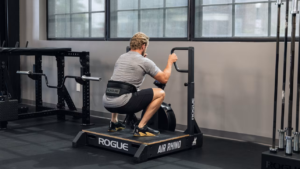
Devices such as the Rogue Air Rhino and Concept2 StrengthErg apply the same broad logic to pressing, pulling, squatting, rowing, and other strength movements: the user creates the resistance through effort, and the fan-based system scales with output.
Where the terminology becomes confusing
Because air resistance devices use a rotating fan or flywheel mechanism, they are sometimes described with the same language used for true flywheel training. Mechanically, though, the stimulus is different.
Air resistance strength devices are typically designed around concentric output. The user drives into the system, the fan creates resistance, and much of that energy is dissipated into the room as airflow.
That is useful for strength endurance, explosive intent, guided resistance, and lower-soreness training. But it is not the same as a closed-loop isoinertial system that stores energy and returns it during the eccentric phase.
What real isoinertial flywheel training is
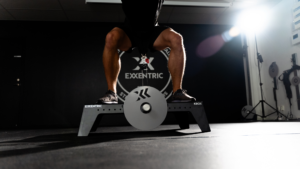
True flywheel training is built around kinetic energy storage. In a genuine isoinertial device, such as an Exxentric kBox or kPulley, the athlete pulls against a strap connected to a solid, weighted flywheel.
During the concentric phase, the user accelerates the flywheel. The harder they push or pull, the more rotational kinetic energy is stored.
During the eccentric phase, the strap rewinds and the spinning flywheel returns that energy. The user must actively decelerate the system, which is where the opportunity for Eccentric Overload emerges.
The key mechanism: energy comes back
In a solid-disc isoinertial system, the user is not just working against resistance on the way out. They must control the returning force on the way back.
By delaying braking toward the end of the range of motion, the athlete can create a high eccentric force demand during the muscle-lengthening phase. This is one reason flywheel training is used in research and practice for strength, power, deceleration, and return-to-performance settings.
Mechanics compared: isoinertial flywheel vs air resistance
The practical distinction
Air resistance asks: how hard can you drive into the system? Isoinertial flywheel training asks: how hard can you drive, and how well can you control what comes back?
Why the research base belongs to true flywheel training
The scientific literature on Flywheel Resistance Training is based on isoinertial resistance, not open-loop fan drag. That matters when interpreting claims, comparing equipment, or designing programs.
Research has investigated flywheel training for strength, power, sprinting, jumping, change of direction, muscle architecture, eccentric overload, and implementation practice. Exxentric’s scientific evidence library also curates a large body of flywheel-related research for coaches, clinicians, and performance teams.
The key point is simple: when a study refers to Flywheel Resistance Training or isoinertial training, it is referring to an inertia-based system that stores and returns energy, not a fan-based conditioning or concentric-output tool.
When to use air resistance fan devices
Air resistance tools are highly useful when the goal is recoverable, repeatable output. That is more precise than simply calling them “conditioning” tools. Their main advantage is that they let athletes produce high effort with a lower eccentric recovery cost.
For rowers, ski ergs, and air bikes, the core value proposition: high-volume work, scalable intensity, measurable output, and relatively low eccentric stress. That makes them excellent for intervals, aerobic development, mixed-modal conditioning, and high-frequency energy-system work where the athlete needs to come back fresh enough to train again.
For newer strength-focused air devices such as the Rogue Air Rhino and Concept2 StrengthErg, the same principle can support guided strength work, concentric power, strength endurance, and additional training volume when reduced eccentric loading is a deliberate advantage.
That is the clearest strength-training use case: concentric-dominant work can help manage recovery limitations. Since eccentric loading creates a relatively greater recovery demand, air resistance devices can be a practical way to add work without adding the same level of eccentric fatigue. If the goal is hypertrophy, however, that reduced eccentric stimulus becomes a limitation rather than a benefit.
When to use isoinertial flywheel training
Eccentric loading makes flywheel systems especially relevant for strength, hypertrophy, athletic power, deceleration, sprint and jump preparation, change-of-direction qualities, tendon and muscle loading, and return-to-performance programming.
For strength and hypertrophy, the eccentric phase matters. Research comparing contraction modes suggests that training with both concentric and eccentric actions generally produces greater strength and muscle-size adaptations than concentric-only work. Standard 1:1 resistance training already benefits from this because the user lifts and lowers the load instead of only producing force in one direction.
Beyond that, seamless eccentric overload may provide an additional stimulus for strength, hypertrophy, muscle architecture, and force-absorption qualities compared with concentric-only training and, in the right setup, potentially beyond standard 1:1 loading.
Several reviews and meta-analyses support the relevance of flywheel training for these outcomes, including research on functional and structural adaptations after eccentric-overload flywheel training, strength-related effects of flywheel training, and hypertrophic effects of eccentric versus concentric muscle actions.
For coaches and clinicians, the value is not just that resistance adapts to the user. It is that the user must control the complete repetition, with the potential to train high-quality concentric output and overload the eccentric phase in the same movement.
Choosing the right gear for the right adaptation
If the goal is metabolic conditioning, repeatable output, or concentric-focused strength work with lower eccentric demand, air resistance can be a strong option.
If the goal is eccentric overload, hypertrophy, force absorption, strength, or a training method supported by the flywheel resistance training literature, genuine isoinertial flywheel training stands apart.
Where Rogue, Concept2, and Exxentric fit in the equipment ecosystem
Rogue and Concept2 have both helped make air resistance training familiar to athletes, coaches, and facilities. Their cardio tools show exactly why fan-based resistance has become so popular: it is responsive, durable, scalable, and easy to use across different ability levels.
Rogue’s catalog also lists Exxentric systems, including the kBox and kPulley, which reinforces the point: air resistance equipment and genuine isoinertial flywheel systems can (and should) coexist in serious facilities because they solve different training problems.
That development is interesting and useful. It just should not be confused with true isoinertial flywheel training, where the defining feature is not simply a spinning component, but the closed-loop return of energy that creates a meaningful eccentric demand.
Technical training summary
| Feature | True Isoinertial Flywheel | Air Resistance Fan Device |
|---|---|---|
| Resistance engine | Solid weighted disc using rotational inertia | Fan blades moving air through drag |
| Energy conservation | Closed loop: energy is stored and returned | Open loop: energy is largely dissipated as airflow |
| Eccentric demand | Central to the method, with potential eccentric overload | Limited compared with closed-loop isoinertial loading |
| Best use | Strength, power, eccentric control, deceleration, rehabilitation | Conditioning, HIIT, concentric output, strength endurance |
Relevant study links and resources
Research reference blockThese links support the distinction between true flywheel resistance training, air resistance strength tools, and the research base behind isoinertial training:
- Skeletal muscle functional and structural adaptations after eccentric overload flywheel resistance training: a systematic review and meta-analysis
- Effects of Flywheel Resistance Training on Sport Actions: a systematic review and meta-analysis
- A systematic review of flywheel training effectiveness and application
- The efficacy of flywheel inertia training to enhance hamstring strength
- Effects of flywheel leg curls on hamstring muscle structure and function
- Current guidelines for the implementation of flywheel resistance training
- Do flywheel exercises provide eccentric-overload training?
- Exxentric scientific evidence library
- Rogue Air Rhino product page
- Concept2 StrengthErg product page
The takeaway
Air resistance fan devices are useful tools. In cardio equipment, the technology makes obvious sense. In newer strength devices, it can also offer a practical way to train concentric output, guided effort, and strength endurance.
True isoinertial flywheel training is different. It stores energy and returns it, forcing the user to manage the eccentric phase. If the goal is eccentric overload, force absorption, explosive strength, or a method supported by the flywheel resistance training literature, the mechanical distinction matters.
See the mechanics in action
To see how solid-disc rotational inertia creates dynamic resistance and eccentric overload, watch Exxentric’s Flywheel Training overview and explore the product range built around true isoinertial loading.