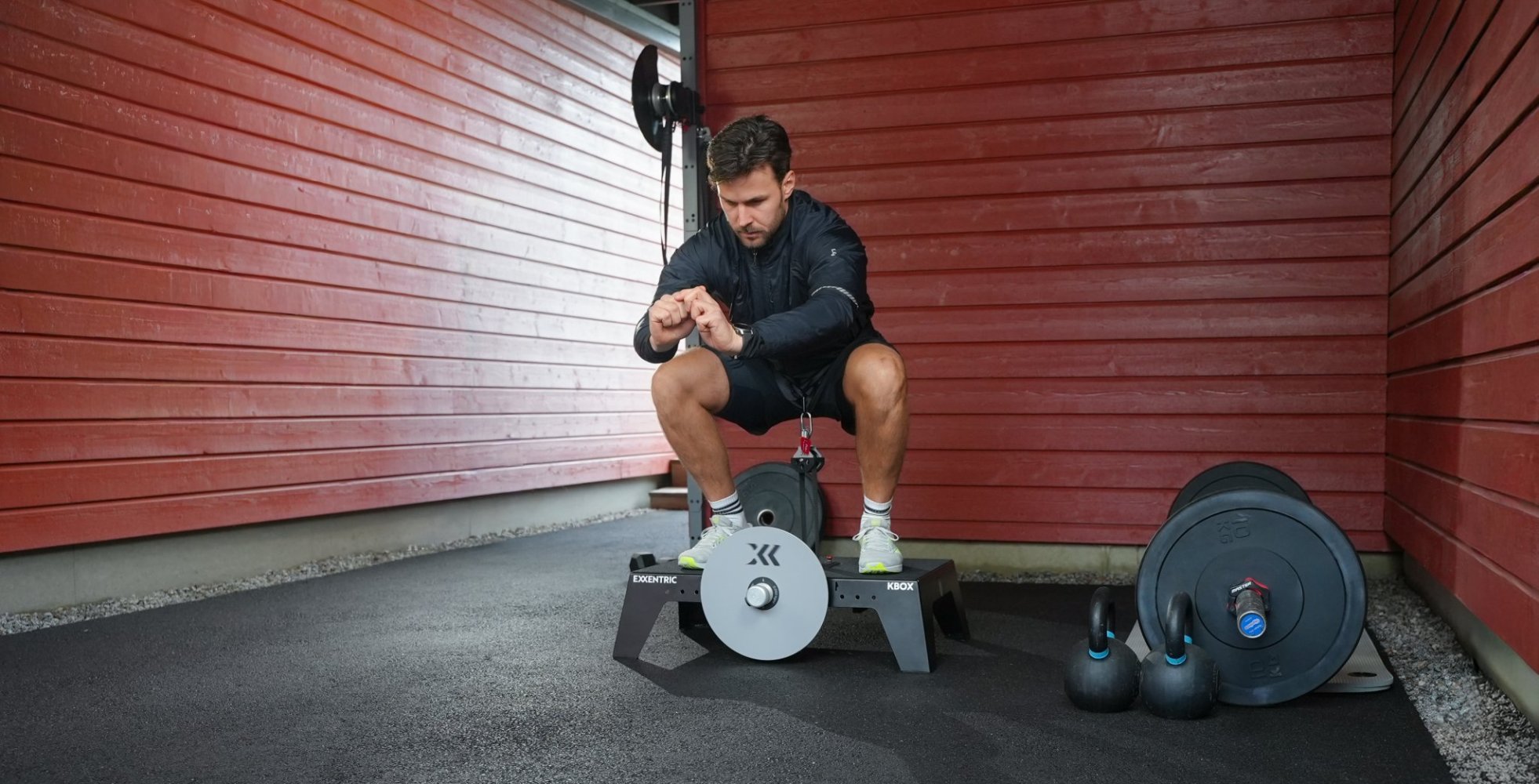
Your First Flywheel Training Session
You know how to squat, hinge or pull with ordinary weights. The first time you use Flywheel Training, the movement may feel familiar while the resistance rhythm feels completely new.
A useful first session is a learning session. Your job is to understand how effort starts the movement, how the flywheel returns energy and how to control that return without trying to prove anything. Once that rhythm makes sense, the equipment becomes much easier to use.
What feels different in the first few reps?
With a barbell or weight stack, the external load is present before you move. In Flywheel Training, you create the resistance by accelerating a rotating flywheel. The energy you put into the concentric phase comes back through the belt or cable, so the return phase becomes part of the repetition.
That can make the exercise feel lighter at the start and more demanding as the flywheel comes back. A harder, faster effort stores more energy, which gives you more to control. The resistance therefore responds to how you move, as well as to the selected inertia.
The timing may take a few repetitions to recognise. You are learning when to accelerate, when the flywheel changes direction and how to keep the movement smooth as the energy returns.
What should you pay attention to?
Three useful observations for a first session
- Rhythm: Does the movement become easier to follow after a few repetitions, or are you rushing to keep up with the return?
- Control: Can you stay organised through the lengthening phase instead of treating the return as something to escape?
- Familiarity: Does the exercise still resemble the strength movement you know, even though the resistance behaves differently?
Let the coach or instructor set the exercise, range and equipment details for the session. Your useful feedback is how the movement feels and what you can control.
Pay attention to the whole repetition rather than only the point where you produce force. Flywheel Training asks you to accelerate the flywheel and then manage the energy it gives back. That makes the return phase an active part of the exercise, even when the movement itself is familiar.
You may also notice that a movement changes character when the exercise, inertia or intent changes. The same system can support different training demands, so the setup should be understood in relation to the exercise rather than judged by the flywheel size alone.
What should you avoid assuming?
Keep these assumptions out of your first session
- Inertia is not a kilogram equivalent. A flywheel setting cannot be read as a direct replacement for a barbell or dumbbell load. Exercise, leverage, range of motion and how you move all affect the demand.
- Eccentric overload is not automatic. Flywheel Training makes it possible to emphasise the eccentric phase, but true eccentric overload requires a specific method. It is an advanced application, not the default experience of every repetition.
- Harder is not always more useful. A higher-effort repetition that you cannot control tells you less than a smooth repetition you can repeat and understand.
- The machine does not replace attention. The resistance responds to your effort, but it does not decide whether an exercise, range or intensity is appropriate for you.
For an overview of the method, see how eccentric overload methods work after you understand the basic movement.
How should you judge the first session?
Use a simple standard: did you leave with a clearer sense of how to interact with the flywheel?
A first session does not need to produce a personal best or settle which resistance method you prefer. It should give you enough experience to recognise the difference between accelerating the flywheel and controlling its return. It should also show you which questions to ask before you progress to a more demanding exercise or method.
If the movement feels unfamiliar, that is useful information. Give the learning process room. Strength-training experience helps you understand the exercise, but it does not remove the need to learn the timing of the resistance.
Start by learning the movement, not chasing the number
Your first Flywheel Training session will be most useful when you treat it as an introduction to a new resistance pattern. Produce a clear effort, notice the energy coming back and learn to control it with the movement your instructor has chosen.
That foundation gives every later session a better starting point.
Review your exercise before you train
Use the official Exxentric exercise library to look over the movement selected for your first session, then arrive ready to learn how it behaves with Flywheel Training.