kBox Active vs kBox Lite vs kBox Pro: Which Platform Fits Your Training?
If you know you want a kBox, the difficult choice is no longer whether flywheel training belongs in your setup. It is which platform fits the way you will train, move the equipment and review progress.
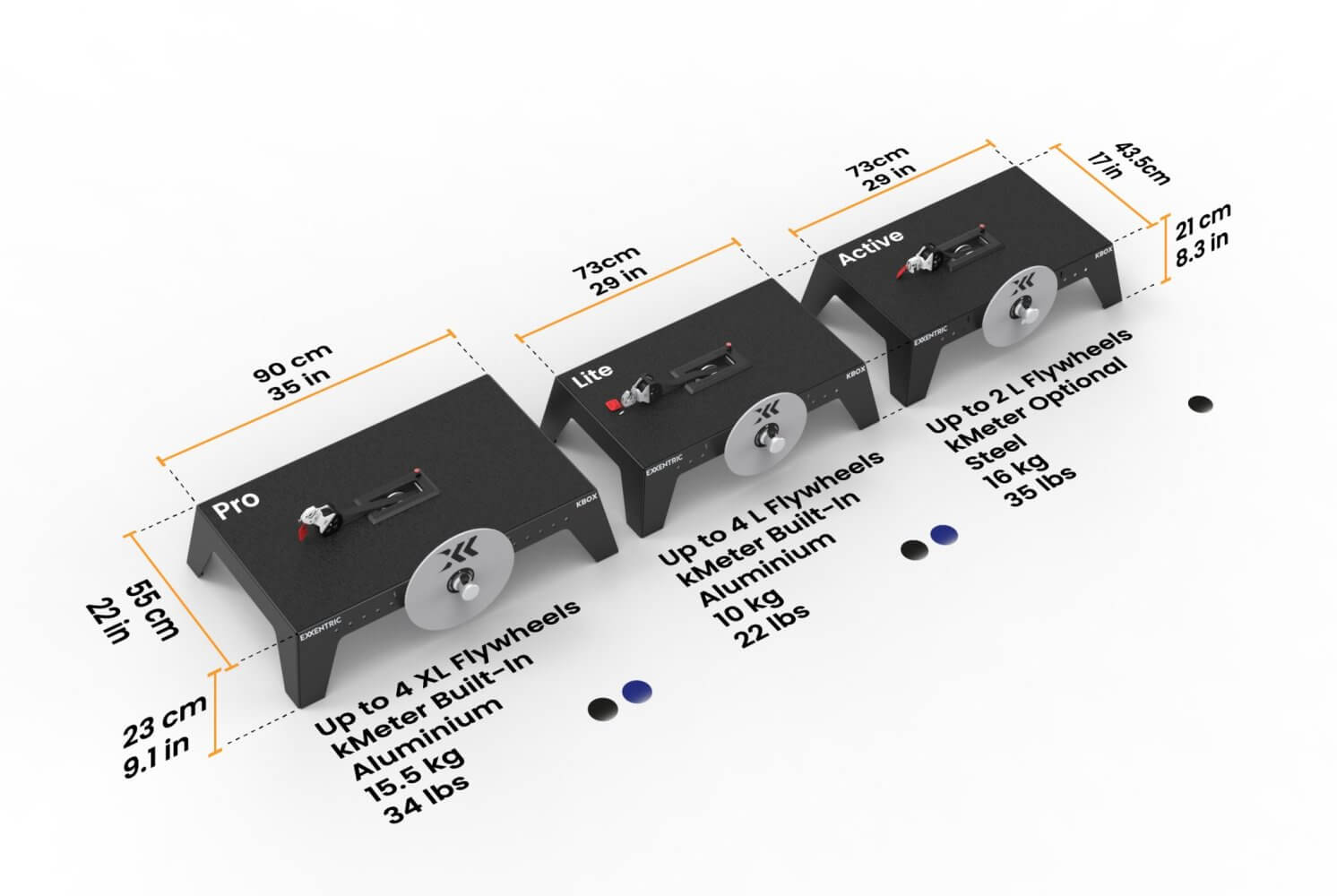
The kBox Active, kBox Lite and kBox Pro share the same platform-based approach to full-body flywheel training. They separate themselves through the details that shape daily use: portability, chassis, flywheel capacity, platform size and kMeter setup. Choose from those realities and the decision becomes much clearer.

Start with your training environment
The best kBox is the one that fits the room, the people using it and the work it needs to support each week.
For home training, personal training and smaller spaces, the kBox Active is the straightforward entry point. For a coach who carries equipment between locations or wants a lighter professional platform, the kBox Lite puts portability first. For high-use performance environments, the kBox Pro adds the largest platform in the range, the broadest stated inertia range and built-in measurement hardware.
Choose kBox Active for a complete home setup
The kBox Active is positioned for hobby athletes and home training. Its steel chassis weighs 16 kg, and the platform accepts up to four large flywheels with the Advanced Flywheel Knob. It has the same compact 73 x 43.5 cm training surface listed for the Active and Lite platforms.
The Active makes sense when you want one platform for a broad range of lower- and upper-body exercises, but your setup is centred on home use, personal training or a small studio. Its system packages can also bring the platform together with common accessories, so the decision is less about building a facility configuration and more about creating a complete starting point. kMeter is optional on the kBox Active, so plan for that need rather than assume it is included in every system.
Choose kBox Lite when portability and feedback matter
The kBox Lite is the mobile professional option. At approximately 10 kg, it is the lightest of the three current platforms, with an aluminium chassis and the same 73 x 43.5 cm training surface as the Active. It accepts up to six large flywheels and has built-in kMeter performance tracking.
That combination gives the Lite a clear role for coaches, travelling practitioners and users who need professional training capability without a heavier platform. Its lower weight matters when the kBox is moved, stored or carried between training spaces. The built-in kMeter matters when output review and repeatable feedback are part of the normal workflow from the start. Its distinct advantage is the balance between capability and transportability.
Choose kBox Pro for facility use and a larger platform
The kBox Pro is designed for elite training and facility usage. It has an aluminium chassis, weighs approximately 15.5 kg and accepts up to six XL flywheels. Its training surface is 60% larger than the surface shared by the Active and Lite, measuring 90 x 55 cm.
That extra platform area changes the physical feel of the setup. It gives coaches and facilities more room to work with when the kBox is used frequently, by larger athletes or across a wider range of training contexts. The Pro also has the broadest stated standard inertia range of the three platforms, from 0.005 to 0.280 kgm², and built-in kMeter performance tracking. It also offers custom design options, which can matter when the equipment needs to belong clearly within a professional environment.
Compare the details that will shape your decision
- Space: Active and Lite share the smaller training surface; Pro provides 60% more area.
- Movement: Active is the heaviest because of its steel chassis; Lite is the lightest; Pro combines a larger platform with an aluminium chassis.
- Flywheel capacity: Active supports up to four large flywheels; Lite supports up to six large flywheels; Pro supports up to six XL flywheels.
- Feedback: kMeter is optional on Active and built in on Lite and Pro.
- Setting: Active is aimed at home training, Lite at portability and pro-level use, and Pro at elite training and facility use.
These are platform and system distinctions, not a ranking of training results. Exercise selection, coaching, inertia choices and consistency still determine how the equipment is used.
Make the platform fit the work you will repeat
Choose the kBox Active when a complete, compact home or small-studio setup is the priority. Choose the kBox Lite when the platform will travel and built-in feedback belongs in the workflow. Choose the kBox Pro when facility use, a larger surface and the highest flywheel capacity in the range justify the bigger platform.
The right platform is the one that removes friction from your actual training week. That is a more useful decision rule than choosing the most advanced specification on paper.
Compare the three kBox platforms
Explore the current kBox Active, kBox Lite and kBox Pro systems, then match the platform to your space, users and training priorities.