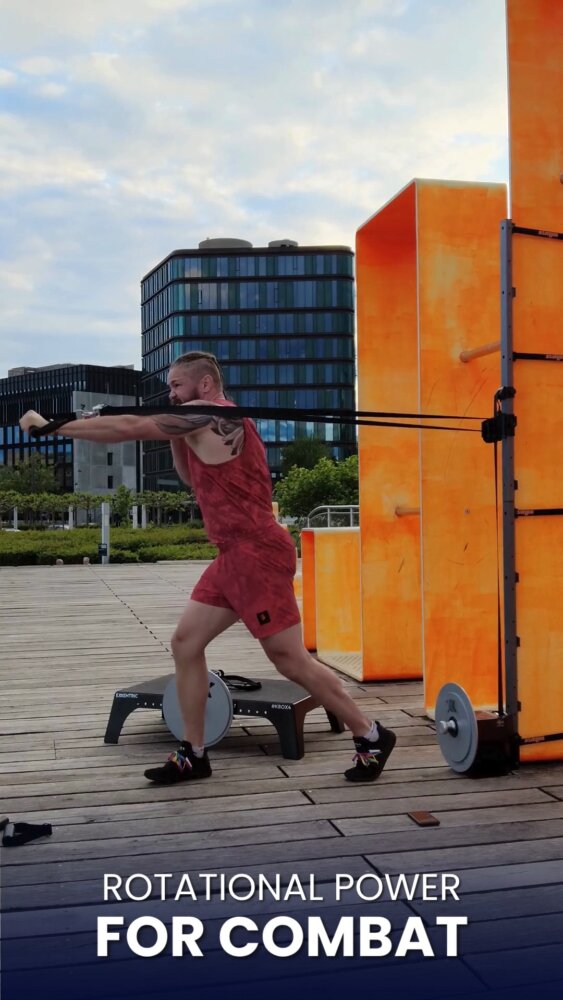
Rotational Power in Combat Athletes: Train to Fight, Not Twist
Executive summary
For striking, throwing, clinching, and grappling, rotational power is not an isolated trunk movement. It is a full kinetic chain that starts at the feet, builds force through the legs, transfers through the hips and trunk, and finishes with enough shoulder, fist, grip, or arm stability to deliver force into the opponent. Flywheel Training is uniquely useful; the resistance responds to the athlete’s effort, allowing high-intent power work while loading each phase of the movement more appropriately than a fixed external load.
Rotational power often gets reduced to cable chops, medicine ball throws, and a few hard turns through the trunk.
Those exercises can have value. But for combat athletes, they only show one piece of the problem.
A punch does not begin at the shoulder. A kick does not begin at the hip. A throw does not begin in the arms. A strong clinch is not just a strong torso. In combat sports, rotation starts from contact with the ground, gathers force through the lower body, turns through the pelvis and trunk, and only becomes useful if the endpoint can stay stable enough to transfer it.
Why variable resistance changes rotational power training
With a barbell or a traditional cable stack, the athlete is often limited by the weakest position in the movement or by a fixed load that does not match the way combat movements unfold.
Flywheel Training works differently. The harder the athlete accelerates the flywheel, the more energy comes back. That makes the load responsive to intent. It allows athletes to push, pull, rotate, brace, and decelerate with maximum effort while the system naturally scales to what they put into the movement.
That is exactly what a heavy strike is supposed to do. It does not ask one muscle group to create power in isolation. It compounds several movements into building maximal momentum, with the feet, legs, hips, trunk, shoulder, arm, and fist each contributing as much as possible toward the highest possible sum output.
For combat athletes, this matters because rotational power is not clean or linear. The body has to produce force, absorb force, and redirect force while stance, timing, leverage, and contact are constantly changing. Exxentric systems such as the kBox and kPulley make it possible to train those qualities across lower-body, hip, trunk, upper-body, and integrated rotational patterns.
Start at the feet: rotational power needs a base
Before an athlete can rotate with force, they need a base that can create pressure into the ground.
In striking, that might be the rear foot driving the floor before the hip turns. In wrestling or judo, it may be the ability to step, plant, and produce force while the opponent is pulling, pushing, or resisting. In mixed martial arts, the athlete may need to rotate from a stance that is narrow, staggered, or compromised.
This is why rotational power training should begin with foot pressure, stance control, and the ability to produce force from realistic positions. If the base collapses, the trunk may still rotate, but the result is noise instead of transferable power.
Build momentum through the legs and hips
The legs and hips are where rotational intent becomes usable momentum.
For combat athletes, this is not only about a heavy squat or an isolated hip turn. It is about producing force in positions that resemble pushing off, changing level, circling, driving through a takedown entry, regaining posture in the clinch, or turning a strike through the floor.
A heavy strike works because multiple segments contribute in sequence. The legs create the first serious impulse. The hips organize and amplify that impulse. The trunk then transfers it. The goal is not to make one phase look powerful on its own, but to help each phase contribute as much as possible to the total output.
Variable resistance is a major advantage here. With flywheel loading, the athlete can attack the whole pattern with intent. As force builds through the squat, lateral drive, pivot, or hip turn, the flywheel responds to the effort being produced. That lets the athlete train maximal power without reducing the movement to the load that one weak point can tolerate.
The returning force also matters. Combat athletes rarely get to produce force and then relax. They have to absorb, reset, brace, or redirect immediately. Flywheel Training keeps that demand inside the exercise by making the athlete control the eccentric return after they have created momentum.
Exercise emphasisUse kBox squats for lower-body force production. Add lateral squats to connect leg strength with side-to-side movement. Progress to squats with rotation, wrestler rotation squats, lateral squat to rotation, rotational hip drives, split-stance hip turns, and loaded pivot variations when the athlete can keep foot pressure, pelvis control, and trunk position organized.
A Harness can help athletes load lower-body and hip-dominant patterns while keeping the arms free for stance, guard, balance, or sport-specific posture.
Trunk amplifies, not initiates
Trunk rotation matters. It just should not be asked to do the entire job.
A strong trunk transfers force. A poorly timed trunk compensates for force that was never built properly in the first place. That distinction is important for combat sports because the athlete must rotate while maintaining posture, breathing, guard position, and awareness of the opponent.
This is where the kPulley becomes a strong fit. Its line of pull allows athletes to train rotational pulls, rotational presses, chops, lifts, rows, and stance-specific trunk patterns from angles that better reflect striking, clinching, throwing, and grappling demands.
Train rotation as force transfer, not just movement
Many rotational exercises measure whether the athlete can turn. Combat performance depends on whether that turn transfers force.
For a punch, power must move from the floor through the legs and hips, through the trunk, and into the shoulder, fist, and target. For a throw or body lock, the athlete must rotate while keeping grip, elbow position, ribcage control, and pressure into the opponent.
Flywheel resistance helps because the athlete cannot simply swing through the pattern and relax. The returning energy forces them to control the end of the movement, absorb load, and organize the next repetition. That makes the exercise less like a disconnected twist and more like a repeated cycle of producing, transferring, and controlling force.
Make rotational progress easier to measure
One limitation of free weights and cable machines is that rotational output can be difficult to track consistently. The exercise may look faster, cleaner, or more powerful, but coaches and athletes often have to rely on observation, feel, or estimated load rather than a clear view of performance from session to session.
With the kMeter and Exxentric App, rotational work becomes easier to monitor and progress. Athletes can get clearer feedback on output, compare training over time, and connect intent with measurable development. When paired with the Rotational Sling, the kPulley becomes an even more practical setup for rotational pulls, throws, twists, and core power patterns where tracking progress matters.
Finish with endpoint stability
Rotational power is only useful if the endpoint can accept and deliver it.
In striking, that endpoint is often the fist and shoulder. A fighter can generate force from the floor, rotate the hip, and turn through the trunk, but if the shoulder cannot stay organized or the fist cannot stay structurally connected, power leaks before impact.
In grappling, the endpoint may be the hand, wrist, elbow, shoulder, or grip position. The same principle applies. The athlete has to transfer force into another body without losing the limb position that makes the technique work.
This is one reason handles and upper-body accessories matter. kGrips, the kBar, and the Upper Body Kit can help coaches set up pushes, pulls, rows, and rotational patterns that challenge the arm as part of the chain instead of treating it as an afterthought.
Anti-rotation may matter even more in the clinch
Not every combat exchange rewards the athlete who can twist harder.
In grappling, clinching, cage work, body locks, takedown defense, and hand fighting, the more important quality is often the ability to resist being twisted. If an opponent can turn your shoulders away from your hips, pull your ribs out of position, or rotate your pelvis before you can recover, your strength becomes difficult to use.
This is where eccentric overload can support anti-rotation work. The athlete produces force, then has to absorb and control the returning pull without losing position. That eccentric demand can make anti-rotation drills feel much closer to the real problem: staying organized while someone or something is trying to turn you.
Anti-rotation exercises for combat athletes
Anti-rotation should not be passive. For combat athletes, it should feel like a fight for position.
The goal is to resist unwanted movement while the feet, hips, trunk, and arms remain connected. That can mean holding a stance under flywheel return, controlling a resisted row without being pulled open, or pressing without allowing the ribs and pelvis to separate.
The best anti-rotation work teaches the athlete to absorb force without becoming rigid. They stay stable enough to hold position, but responsive enough to move again.
How to program flywheel rotational power work
Rotational power training should be placed where quality is still high. For most combat athletes, that means after the warm-up and before heavy fatigue-based conditioning.
Use lower inertia and higher speed when the goal is sharp rotational power. Use moderate inertia when the goal is force production and force absorption through a larger pattern. For anti-rotation and clinch-style work, the key is not just load. It is whether the athlete can stay connected as the flywheel pulls them back.
Coaches can build a session around one lower-body pattern, one hip or trunk rotation pattern, one endpoint stability pattern, and one anti-rotation pattern. That keeps the training specific without turning it into a long list of disconnected core drills.
Movement and equipment starting points
For combat athletes, the strongest setup is often a combination of platform-based lower-body work and pulley-based rotational or anti-rotational work. The kBox covers squats, lateral squats, split-stance work, hip extension, and lower-body force production. The kPulley is a natural fit for pulls, presses, chops, lifts, rows, rotational patterns, and endpoint stability drills, especially when paired with accessories such as the Rotational Sling.
Explore the equipment and exercise library to match the setup to your athletes, space, and programming goals.
The bottom line
Flywheel for rotational power is not about making combat athletes twist harder.
It is about training the whole chain that makes rotation useful: feet that can create pressure, legs that can build force, hips that can direct it, a trunk that can transfer it, and limbs that can finish or resist the exchange without leaking power.
For strikers, that means force that arrives through the fist and shoulder with control. For grapplers, it means rotation that can create leverage, and anti-rotation that can protect position when an opponent tries to turn them. That is the real advantage of flywheel work for combat athletes: it trains power and control as two sides of the same movement problem.
Key takeaways
- Rotational power for combat athletes should be trained as a full kinetic chain, not as isolated trunk rotation.
- Useful rotation starts at the feet, builds through the legs, organizes at the hips, transfers through the trunk, and finishes through a stable endpoint.
- Flywheel Training provides responsive variable resistance, allowing athletes to train high-intent power while also controlling the eccentric return.
- kBox patterns are especially useful for lower-body force production, lateral strength, and squat-to-rotation progressions.
- kPulley patterns are especially useful for rotational pulls, presses, chops, lifts, rows, anti-rotation, and endpoint stability work.
- The kMeter and Exxentric App help make rotational output and progress easier to track than with free weights or cable machines alone.
- In grappling and clinching, resisting rotation can be as important as producing it.
Train rotational power that holds up in contact
For combat athletes, rotational power has to survive pressure, timing, and resistance. Explore Combat Sports applications, the kBox, the kPulley, the Exxentric App, and rotational accessories to build flywheel-based rotational, anti-rotational, and full-chain power work into your program.
“We’ve been using Exxentric devices with our combat athletes for a while now, and the main draw for us is just how versatile the setup is.
On one end, it’s great for deceleration and change-of-direction drills, helping fighters move better on the mats and control distance under dynamic load. On the other, we frequently use it concentrically to get athletes focusing purely on grounding and generating maximum force as fast as possible.
We don’t drop traditional lifting altogether during fight camp. Instead, we blend flywheel work with heavy compound lifts. It fills a specific stimulus gap that barbells can’t always address.”
Rehab & Performance Physiotherapy Pattaya