
Attention All Runners: Build Better Economy, More Resilience, and More Speed with Flywheel Training
Executive summary
Running economy is not only aerobic. It is mechanical. Runners need to produce force, absorb force, and keep doing both efficiently for thousands of strides. Flywheel Training is especially relevant because it challenges both force production and eccentric control. That makes it a strong fit for runners who want better pace durability, stronger late-race mechanics, more resilient tissues, and better transfer from gym work into the stride.
Strength training should make you a better runner, not just a more tired one. That sounds obvious, but it is where a lot of strength work for runners misses the mark. If gym work adds fatigue without improving stride quality, durability, or speed, it becomes background noise.
The real question is whether strength training helps a runner use less energy at a given pace, tolerate more load across a season, and still hold form when fatigue builds. This is where Flywheel Training becomes especially relevant.
Why strength matters for runners
Running can look simple from the outside, but every stride is a force-management task. The body has to absorb impact, stabilize joints, organize posture, and push back into the ground efficiently. Over the course of a 5K, half marathon, or hard interval session, that demand adds up quickly.
This is why strength work belongs in a serious running program. Not because runners need to train like powerlifters, but because they need better force control, better posture under fatigue, and a stronger ability to keep contributing through the hips, hamstrings, calves, and trunk late in the effort.
Why Flywheel Training is different for runners
Traditional weights can help runners get stronger, but Flywheel Training adds something highly relevant to running: the ability to produce force and then control the returning force during the eccentric phase.
With Exxentric systems such as the kBox and kPulley, the harder the athlete works in the concentric phase, the more energy comes back in the eccentric phase. For runners, that means training not only propulsion, but also braking, control, and re-acceleration.
Running economy is not just aerobic
Performance in running is not only about cardiovascular fitness. It is also about how efficiently the body handles force. Two runners can have similar aerobic capacity and move very differently. One looks smooth and composed. The other spends more energy holding the same pace. The difference is often mechanical.
Efficient runners tend to manage ground contact well, limit unnecessary movement, and keep posture organized. Strength can help here in a simple way: if a runner has higher force capacity, each stride can demand a little less relative effort. Better muscle recruitment and better coordination can also help the runner apply force more cleanly, which supports a smoother stride at the same pace.
Many experienced runners describe the breakthrough as learning to run from the hips rather than just the legs. The cue is simple, but the effect is not. When the hips stay involved, the stride often feels smoother, lighter, and more sustainable over time.
That idea connects naturally to Flywheel Training. Exxentric systems such as the kBox and kPulley are useful because they challenge runners to produce force through the hips, control the return, and keep the posterior chain involved instead of letting the stride become a lower-leg-only pattern.
Why eccentric overload matters for resilience
Every step includes a braking demand. The body lands, controls load, and has to transition back into force production again and again.
That makes eccentric capacity highly relevant for runners. Flywheel Training can help develop tissue tolerance, single-leg control, and posterior-chain strength in a way that feels more connected to the demands of repeated running than general gym work alone. It also matters because running is elastic: tendons help store and return energy stride after stride, so better force handling and tendon stiffness can support a lighter, more economical stride.
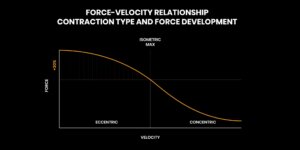
Technical performance summary
The value of Flywheel Training for runners depends on the goal, but the strongest use cases tend to involve force absorption, posture under fatigue, unilateral control, and the ability to keep applying force efficiently over time.
The practical advantage: better late-race mechanics
Runners rarely lose performance all at once. Usually they lose it in pieces. Stride length shortens. Posture drops. Ground contact gets heavier. The hips stop contributing as well. What looked economical early in the race no longer looks economical in the final third.
This is where Flywheel Training can earn its place. By developing force and control together, it can help runners keep more of their original stride quality when fatigue rises.
The practical shift
The best question is not whether runners should get stronger in general. It is whether their strength work helps them stay efficient, stable, and forceful when the race starts to cost more. That is the stronger case for Flywheel Training.
How runners can use Flywheel Training
Most runners do not need endless gym volume. They need enough quality to create adaptation without ruining key running sessions.
In most cases, one to two Flywheel Training sessions per week is enough. The goal is not to leave the gym destroyed. The goal is to build qualities that transfer to the road, track, or trail.
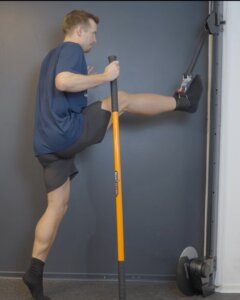
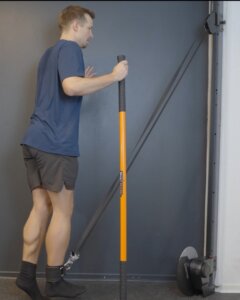
A useful setup can start with movements most runners understand immediately: kBox squat patterns, split squats, unilateral lunges, calf raises, and other unilateral lower-body work. Hamstring work and runner-relevant kPulley patterns such as standing leg curls or hip extension variations can then support those foundations. The emphasis should stay on intent, control, and movement quality.
A simple runner example
Imagine a competitive amateur 5K runner who keeps fading in the final kilometer. The aerobic work is there, but posture softens, stride quality drops, and pace slips when it matters most.
Now add two Flywheel Training sessions per week for eight weeks: one built around squat and split-squat patterns, and one built around unilateral control, hip extension, and hamstring work. The likely gain is not flashy. It is more useful than flashy. Pace feels easier to support, hard sessions create less structural breakdown, and more of the original stride stays available late in the race.
Where traditional strength training still fits
This is not an argument against traditional strength work. Heavy barbell and machine-based training still matter, especially when the goal is general strength development. They can build capacity that supports long-term performance.
The better view is that Flywheel Training gives runners another tool, one that may create a more specific stimulus when the aim is better control of force, stronger eccentric loading, and a cleaner bridge from gym work to running performance.
Why the timing works right now
Late August and September are full of public proof points around what endurance performance really demands.
From Lausanne on August 21, Silesia on August 23, and Zurich on August 27 in the Diamond League, to WTCS Weihai on August 29, IRONMAN 70.3 Vichy on August 23, IRONMAN 70.3 Poznan and Zell am See-Kaprun on August 30, and the IRONMAN 70.3 World Championship in Nice on September 11 to 13, the same theme appears again and again: fitness matters, but so does holding shape, force, and rhythm when fatigue rises.
Why this fits Exxentric Flywheel Training
Exxentric systems are built for athletes who need strength that transfers.
For runners, that means more than leg strength in isolation. It means better force management, stronger braking capacity, and a more resilient stride under fatigue.
The kBox is especially strong for lower-body strength and split-stance patterns. The kPulley adds valuable options for hip extension, trunk control, and posterior-chain work that complement a runner’s needs well, especially when those exercises are tied clearly to the stride.

Technical Performance Summary
|
Running Quality
|
Flywheel Focus
|
Runner Payoff
|
|---|---|---|
|
Running Economy
Efficiency at pace
|
Force absorption
Cleaner mechanics
|
Less wasted motion
Lower cost at pace
|
|
Tissue Resilience
Load tolerance
|
Eccentric overload
Hamstrings, hips, calves
|
Better durability
Supports consistency
|
|
Single-Leg Control
Stride-specific strength
|
Unilateral loading
Hip and trunk control
|
Stronger stride support
Better control late
|
|
Speed Durability
Late-race quality
|
Power plus control
Usable force when tired
|
Stronger finish
Less breakdown late
|
Movement examples
Explore these movement examples to see how Flywheel Training can support runner-specific lower-body strength, posterior-chain development, and eccentric control. For many amateurs, exercises such as standing leg curls and hip extension make the kPulley connection much easier to understand.
The bottom line
Runners do not just need stronger muscles. They need better-functioning strides.
They need to absorb force well, produce force efficiently, and keep doing both when the race gets harder.
That is why Flywheel Training deserves a real place in running performance. It can help improve running economy, support resilience, and develop the kind of strength that feels useful where runners actually care about it most: on the road, track, or trail.
Key takeaways
- Running economy is not only aerobic. It is also mechanical and depends on how efficiently runners manage force.
- Flywheel Training is especially relevant because it loads both force production and eccentric control.
- For runners, the strongest benefits are likely to be better stride organization, more tissue tolerance, and stronger late-race mechanics.
- Most runners can use Flywheel Training effectively with one to two sessions per week.
- The kBox and kPulley offer a practical way to build running-relevant strength without bloating gym volume, especially when exercise selection stays runner-specific.
- The strongest current case is practical and biomechanical. Direct flywheel evidence for aerobic performance and running economy is still limited, and the cited study is broader athletic background rather than direct running proof.
Train strength that carries into every stride
Explore how Exxentric Flywheel Training systems can help runners develop the force production, eccentric control, and late-race resilience needed for better performance.
Reference page: https://hrcak.srce.hr/341897
Most relevant points: The review found that Flywheel Eccentric Overload Training produced stronger improvements than conventional resistance training in change of direction, countermovement jump, and short-distance sprint performance. For runners, that supports the broader case that eccentric overload can be useful when the goal is more usable force, better braking capacity, and improved movement quality rather than general strength alone.