


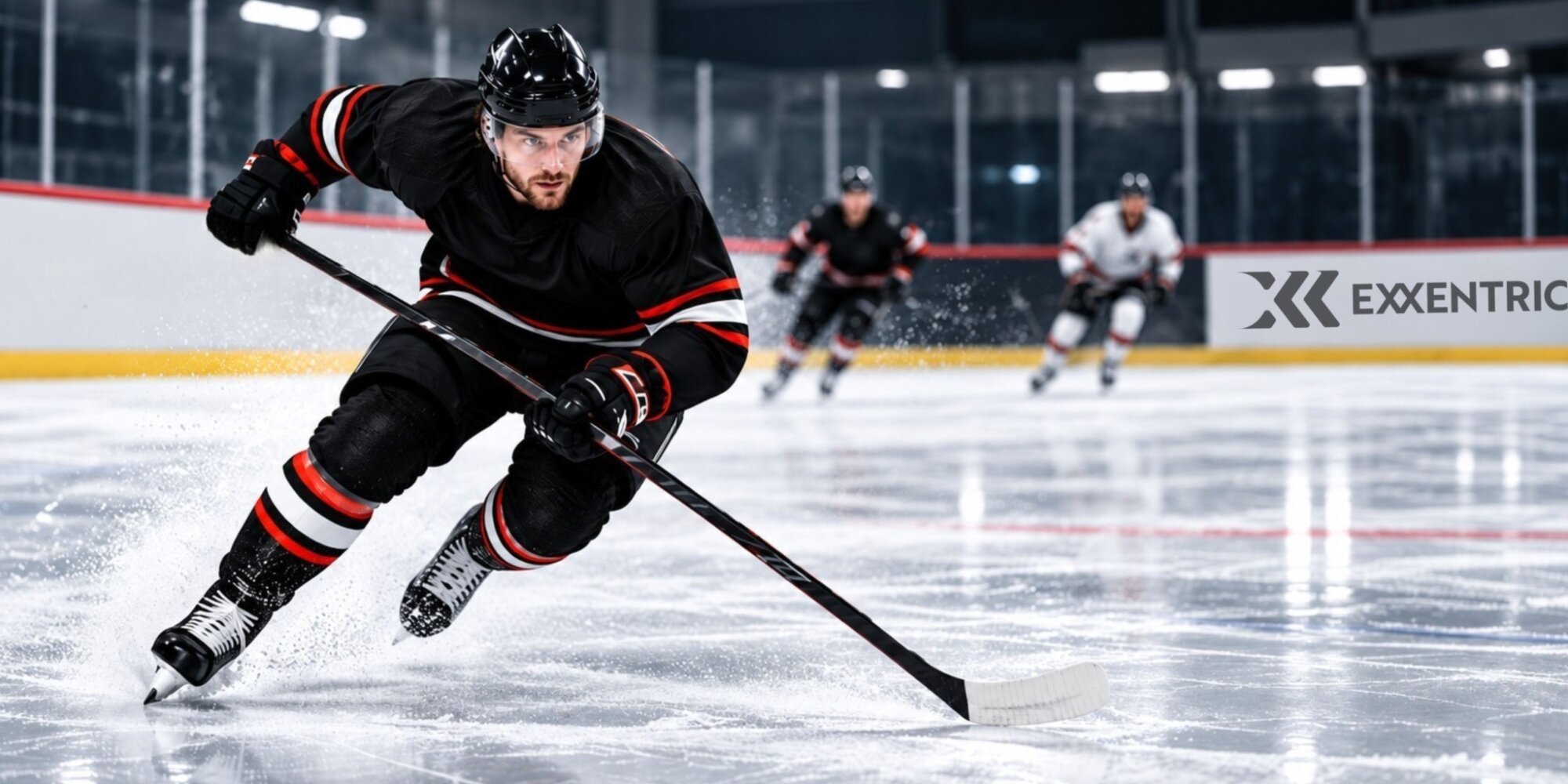
Flywheel Training for Ice Hockey: Be First to the Puck
Hockey IQ tells you where that is. Your legs decide whether you arrive first, and whether you can keep arriving first deep into the third period.
Every decisive play contains a race hidden inside it: stop, read, redirect, and accelerate. The advantage rarely comes from straight-line speed alone. It comes from controlling momentum and turning it into the next powerful stride before your opponent can do the same.
That is the physical problem Flywheel Training has helped elite teams prepare for over the past decade, including the Stanley Cup champion Carolina Hurricanes. Produce force. Absorb it. Reverse it. Then repeat the sequence without allowing fatigue to disrupt the timing that made the first stride effective.
Win that transition and you give your hockey IQ time to matter. Lose it, and knowing where the puck is going may not be enough.
Hockey conditioning is not only about surviving the shift
Professional hockey is built around repeated high-intensity shifts, commonly lasting about 30-80 seconds, with recovery on the bench before the next effort. Across a game, players repeatedly accelerate, decelerate, turn, battle, and reorganise their position.
Research on late-game performance is not perfectly uniform. Some studies report declines in skating speed, accelerations, decelerations, or repeated-sprint ability, while an eight-game professional dataset found no clear third-period fatigue pattern, possibly because players received longer rest intervals. Tactics, position, shift length, score, and rotation all influence what appears on the ice.
The practical conclusion is not that every player inevitably slows by the same amount. It is that fatigue can compromise the high-force actions that decide space: closing a gap, stopping at the puck, escaping pressure, or winning the first two strides after a turn.
Late-game conditioning should therefore protect movement quality, not merely raise tolerance for feeling tired.
The decisive action is brake, organise, drive
Brake
Accept force through the hips and legs without drifting through the play.
Organise
Keep enough position and stiffness to direct the next action rather than adding a recovery step.
Drive
Turn force absorption into the next stride, cut, or battle with as little delay as the situation allows.
Why Flywheel Training for ice hockey targets the brake-to-push problem
When a player decelerates, muscles are working eccentrically as they lengthen under load. The next push is concentric: force is produced to accelerate the body in a new direction. The time between those actions matters.
On the ice, that transition is shaped by skating skill, blade angle, decision-making, anticipation, and contact. No gym exercise can recreate it completely. The gym can, however, build more physical capacity for the sequence underneath it.
On a flywheel system, the athlete accelerates the flywheel and then has to control the energy returning through the strap. Every repetition asks for force production followed by force absorption. With the right movement and coaching, the athlete then reverses into the next repetition without losing position.
That is not skating practice. It is off-ice strength training for the physical problem skating repeatedly presents.
What elite hockey preparation looks like
The Carolina Hurricanes offer a useful real-world example. In team training footage, the reigning Stanley Cup champions use the kBox extensively within their physical preparation. Multiple athletes can use one platform across different exercises, effort levels, and training phases.
The kBox provides variable resistance that responds to the athlete’s effort on every repetition. Push harder and more energy enters the flywheel, creating more resistance to control on the return. When output changes, the returning demand changes with it. Selected inertia still shapes the speed and force characteristics of the exercise, but the resistance is created by what the athlete produces rather than a fixed external weight.
For a team, that creates a compact way to train bilateral strength, unilateral control, lateral force, and repeated high-output work. It also makes progression measurable when the kMeter and Exxentric App are used to track concentric and eccentric power.
The Hurricanes example shows how the kBox can operate as part of a complete performance system: heavy lower-body strength, faster power work, lateral loading, and repeatable output on the same platform. That breadth matters across a long season because the physical priority can change without requiring a different training system.
At the elite level, the value is not novelty. It is having one measurable system that can keep serving the next performance priority.
Build the qualities behind the cut
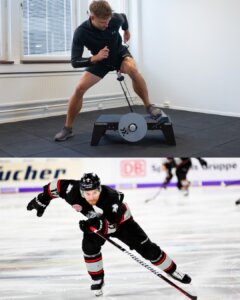
Few exercises connect the kBox to hockey as clearly as the lateral squat. It loads the athlete in the frontal plane, asking one leg to accept the flywheel’s returning force before driving the body back in the opposite direction. That makes it directly relevant to the physical qualities behind skating, braking, and change of direction.
The kBox version is distinctive because the athlete can stand on the platform and work laterally against variable flywheel resistance through a continuous produce-brake-reverse cycle. The Foot Block creates a stable angled surface for the resting foot, helping the player establish a repeatable lateral position and direct force through the working leg.
It is not a resisted skating drill. It is a uniquely practical kBox exercise for developing the lateral strength, eccentric control, and redirection capacity that skating and change of direction demand.
For heavy lower-body work, the Harness distributes load through the shoulders and keeps the hands free. The adjustable Hip Belt offers a quick alternative for squats and lunges. Both help a performance department match the attachment to the athlete while moving a full roster efficiently through training.
A concise off-ice framework for braking and reacceleration
This example is a starting framework, not a copy of Carolina’s programme. Training age, ice load, competition density, position, injury history, and the rest of the strength and conditioning plan should shape the final prescription. The kBox exercise library provides movement demonstrations.
Strength and braking emphasis
- kBox squat: 3 sets of 5-8 controlled repetitions.
- kBox split squat: 3 sets of 5-6 repetitions per side.
- kBox Romanian deadlift: 2-3 sets of 6-8 repetitions.
Lateral force and faster transition emphasis
- kBox lateral squat with Foot Block: 3 sets of 5-6 repetitions per side.
- kBox squat with faster concentric intent: 3 sets of 4-6 quality repetitions.
- Short repeated sets: stop when power or control drops beyond the target set by the coach.
Begin with manageable inertia and learn to brake the flywheel smoothly. Progress intent, inertia, range, or volume one variable at a time. Place demanding eccentric work far enough from games and high-intensity ice sessions to protect performance and recovery.
Metabolic conditioning for the next shift
Hockey does not ask for one great effort. It asks players to repeat high-intensity work across a succession of shifts, recover on the bench, and produce again when the next opportunity arrives. Metabolic conditioning should therefore build repeatable output, not simply make a player tolerate longer periods of fatigue.
On the kBox, coaches can organise squats, lateral squats, and other large lower-body movements into short timed bouts or clusters with planned recovery. Exercise choice, inertia, work duration, and rest determine whether the emphasis sits closer to explosive repeat efforts or longer local muscular conditioning.
Variable resistance is especially useful here because the returning demand follows the effort available on each repetition. Live rep data can then show whether useful power is being maintained or whether the athlete is merely continuing after quality has disappeared.
This work complements on-ice repeated-sprint training and aerobic conditioning. Its role is to strengthen the muscular engine behind repeated acceleration, braking, and redirection, then give coaches objective feedback on how well that engine holds up.
Use power drop-off to train the right kind of fatigue
More fatigue is not automatically better conditioning. If every repetition becomes slow and poorly controlled, the session may be teaching the athlete to tolerate deteriorating output rather than preserve it.
The Exxentric App and kMeter can show concentric and eccentric power and allow a set to end at a defined power or force drop-off. Coaches can use that feedback to keep a power session truly powerful or to structure repeated efforts around a deliberate loss threshold.
That is one piece of late-game conditioning, not the whole solution. Aerobic development, repeated skating, recovery between shifts, tactical pacing, nutrition, and on-ice skill all matter. The kBox addresses the muscular side of repeatedly producing, absorbing, and redirecting force.
The goal is not to make the athlete exhausted in the gym. It is to make useful force harder to lose on the ice.
The next stride starts with the stop
The lesson is bigger than one team. Hockey rewards players who can arrive fast, control the arrival, and leave again with intent.
Flywheel Training for ice hockey develops the force-production and force-absorption qualities behind that sequence. The kBox does not teach the read, choose the edge, or replace skating. It gives coaches a practical way to strengthen the legs that have to execute those skills repeatedly.
Late in the game, the advantage may not belong to the player who can simply go hardest. It may belong to the player who can still stop well enough to go again.
Author: Lexxi and Exxentric Content team. Lexxi is an AI trained and supervised by the human Exxentric Content team. She helps the team with writing and never works alone.
Build the physical qualities behind the next stride
Explore the kBox Advanced System or talk to an Exxentric expert about a setup for your team.
Research references
Professional hockey game demands: Rago, V., Muschinsky, A., Deylami, K., Vigh-Larsen, J. F., & Mohr, M. (2022). Game Demands of a Professional Ice Hockey Team with Special Emphasis on Fatigue Development and Playing Position. Journal of Human Kinetics, 84, 195-205. DOI: 10.2478/hukin-2022-000078. Data from 17 players across eight games showed high acceleration and deceleration demands but no clear third-period fatigue pattern, illustrating the influence of position, playing time, and recovery.
Late-game skating fatigue: Brocherie, F., Girard, O., & Millet, G. P. (2018). Updated analysis of changes in locomotor activities across periods in an international ice hockey game. Biology of Sport, 35(3), 261-267. DOI: 10.5114/biolsport.2018.77826. This detailed analysis found less high-intensity skating in the third period, but it examined one international match and should not be treated as a universal game pattern.
Flywheel training and change of direction: Chaabene, H., et al. (2022). Effect of Flywheel versus Traditional Resistance Training on Change of Direction Performance in Male Athletes: A Systematic Review with Meta-Analysis. International Journal of Environmental Research and Public Health, 19(12), 7061. DOI: 10.3390/ijerph19127061. Seven studies favoured flywheel training for change-of-direction performance, but the evidence was not specific to ice hockey or NHL players.
Unilateral and bilateral kBox training: Núñez, F. J., et al. (2018). The effects of unilateral and bilateral eccentric overload training on hypertrophy, muscle power and COD performance, and its determinants, in team sport players. PLOS ONE, 13(3), e0193841. DOI: 10.1371/journal.pone.0193841. Both kBox groups improved several power and 90-degree change-of-direction measures; participants were young male team-sport players, not hockey players.
Championship context: Carolina Hurricanes (2026). Carolina Hurricanes Win 2026 Stanley Cup Final. The Hurricanes finished the postseason 16-3 and defeated Vegas in six games. This establishes the championship context, not a causal relationship between any training method and competitive success.
Evidence note: Hockey research directly supports the importance of repeated acceleration, deceleration, high-intensity skating, and recovery. Broader flywheel research supports strength, power, and change-of-direction development. The late-game hockey applications in this article are evidence-informed programming rationale, while the Hurricanes footage documents elite use rather than proof that kBox training produced the championship outcome.
