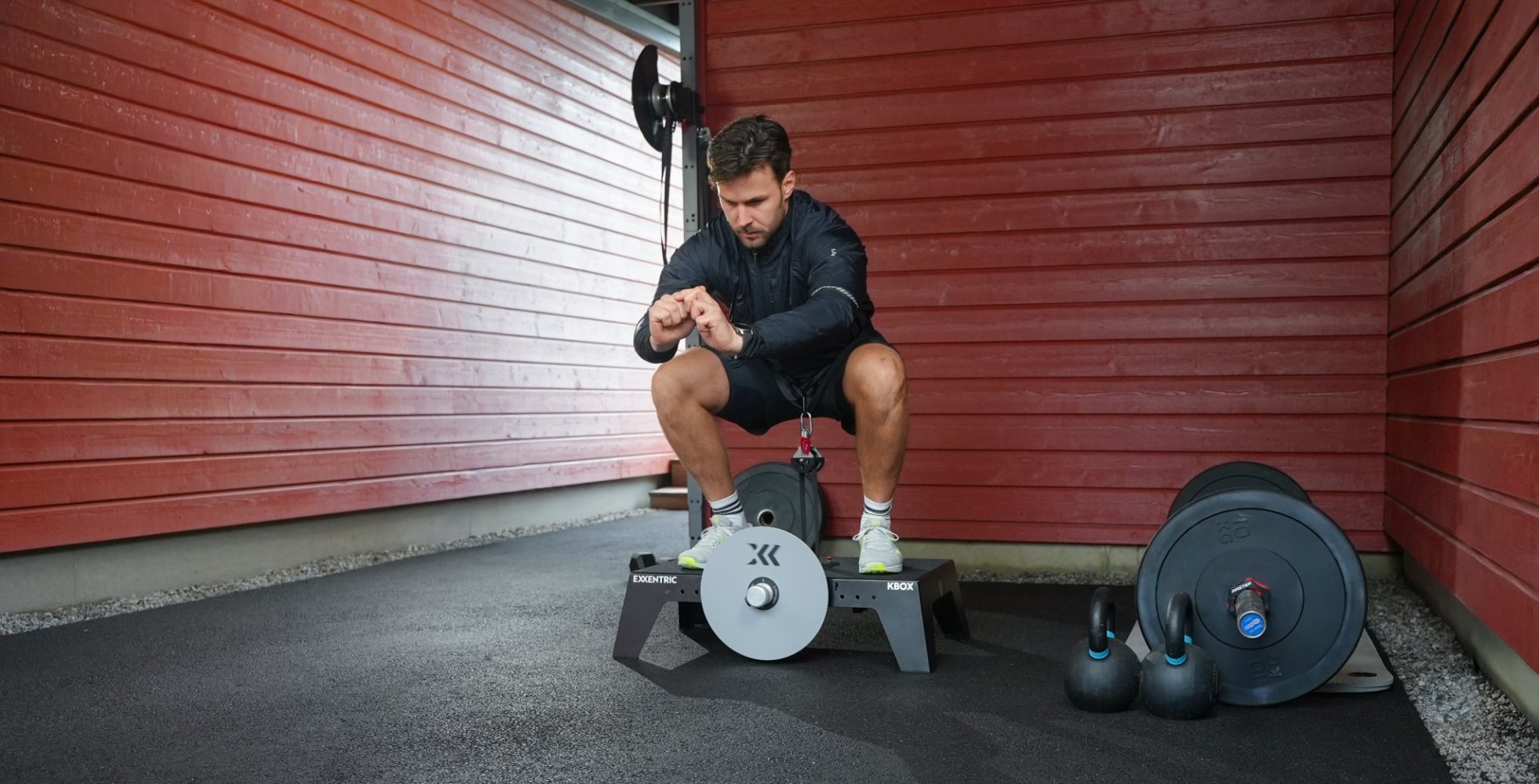
Can You Get Better Results From 40% Less Training?
Executive summary
In an 8-week squat study, trained lifters who stopped their sets when repetition speed dropped by 20% achieved similar strength gains, improved countermovement jump more, and completed roughly 40% fewer repetitions than lifters who continued until a 40% velocity loss threshold.
Please note, the 20% number in the research should not be directly applied to flywheel training. The study used traditional weight training, where the load is fixed. Flywheel training behaves differently: you can push maximally on every repetition while the resistance adapts to your output. Because of this, a 20% velocity drop can already be a large loss of quality when training for power. For power-focused flywheel work, a better starting point is to experiment closer to around 10% velocity loss.

We have been conditioned to believe that more is always better in the gym.
More reps. More fatigue. More time under tension. More soreness the next day.
But if your goal is to get stronger, move better, and maintain power, more is not always the answer. Sometimes the better question is: when should the set stop?
What velocity loss training actually measures
Velocity loss is the drop in movement speed that happens as fatigue builds during a set.
Think about a set of squats. The first few reps usually feel sharp and powerful. As the set continues, the reps slow down, your movement quality changes, and the work starts to feel more like survival than performance.
Velocity loss gives that drop-off a number. Instead of only asking how many reps you completed, it asks:
How much did your performance decline during the set?
That matters because the slowest, hardest reps are not always the most useful reps. They may build fatigue faster than they build the specific quality you are trying to improve.
The study: 20% vs. 40% velocity loss
Researchers took two groups of trained lifters and put them through an 8-week squat program. Both groups used similar loads, followed a similar schedule, and performed the same main exercise.
The main difference was the stopping point.
The lower-fatigue group stopped each set when squat speed dropped by 20% compared to their fastest rep. The higher-fatigue group continued until squat speed dropped by 40%.
If more fatigue always produced better results, the 40% group should have clearly outperformed the 20% group. That is not what happened.
What the velocity loss study found
The 20% velocity loss group produced similar squat strength gains, improved countermovement jump more, and completed substantially less total work. The key point is not that hard training is bad. It is that training deep into fatigue is not always the best route when the goal is performance.
Why stopping earlier can help maintain performance
When you push a set deep into fatigue, the reps become slower and less explosive. That may be useful in some contexts, but it is not always ideal if you want to stay powerful, athletic, and fresh enough to train consistently.
The muscle data from the study supports this. The higher-fatigue group showed a greater shift away from the fastest muscle fiber characteristics, while the lower-fatigue group better preserved qualities associated with explosive output.
In practical terms, lower velocity loss helps you keep the session focused on high-quality repetitions instead of grinding through work that may mainly add fatigue.

Traditional weights and flywheel training are not the same
This is the key practical point: the 20% threshold from the squat study should be treated as a research finding from traditional weight training, not as a universal prescription for every training method.
In traditional lifting, the external load is fixed. If you squat 100 kg, the load stays 100 kg whether the rep is fast, slow, sharp, or grinding. As fatigue builds, the bar slows down, but the load itself does not change in response to your effort.
Flywheel training works differently. With flywheel resistance, you can push or pull maximally on every repetition, and the resistance adapts to the effort you produce. The harder you accelerate the flywheel, the more energy returns in the eccentric phase.
That difference matters. Because flywheel resistance adjusts to maximal effort, a 20% velocity drop can already be a large reduction in rep quality when the goal is power, speed, or high-output training. In that context, waiting until a 20% drop may create more fatigue than you actually want.
For power-focused flywheel training, the safer and more practical starting point is to experiment closer to around 10% velocity loss. This keeps the set focused on fast, high-quality repetitions while still allowing the user to produce meaningful effort on every rep.
A useful way to think about it is this: 20% was the lower-fatigue condition in the traditional squat study, but it may already be a fairly fatiguing target on a flywheel device when power is the priority.
A simple rule of thumb:
10% – 20% Minimal fatigue. Best for Power & speed.
20% – 30% Moderate fatigue. Best for Strength.
40%+ High fatigue / near failure. Best for Hypertrophy.
Higher velocity drops still have a place
Lower velocity loss is valuable when the goal is to protect power, speed, and movement quality. But that does not mean higher velocity drops are wrong. The right threshold depends on the outcome you are training for.
If the primary goal is hypertrophy, a higher drop-off can be very effective. A threshold around 30% velocity loss can create a deeper muscular inroad, which may be useful when the aim is to stimulate muscle growth rather than preserve maximum power output.
This becomes especially relevant when total training volume is intentionally lower. If you are doing fewer sets, shorter sessions, or fewer sessions per week, allowing one set to reach a larger drop-off can make that set more productive for hypertrophy and may reduce the need for several additional sets.
In other words, a low drop is not automatically better. It is better for certain goals. For power-focused flywheel work, start conservatively around 10%. For hypertrophy-focused work with lower total volume, a higher drop such as around 30% can be a strong option.
The main principle is simple: use lower velocity loss to protect performance, and consider higher velocity loss when the goal is muscle growth and the overall training volume is lower.
How Exxentric makes velocity loss easier to apply
The difficult part is not understanding the concept. It is knowing when performance is actually dropping during a set.
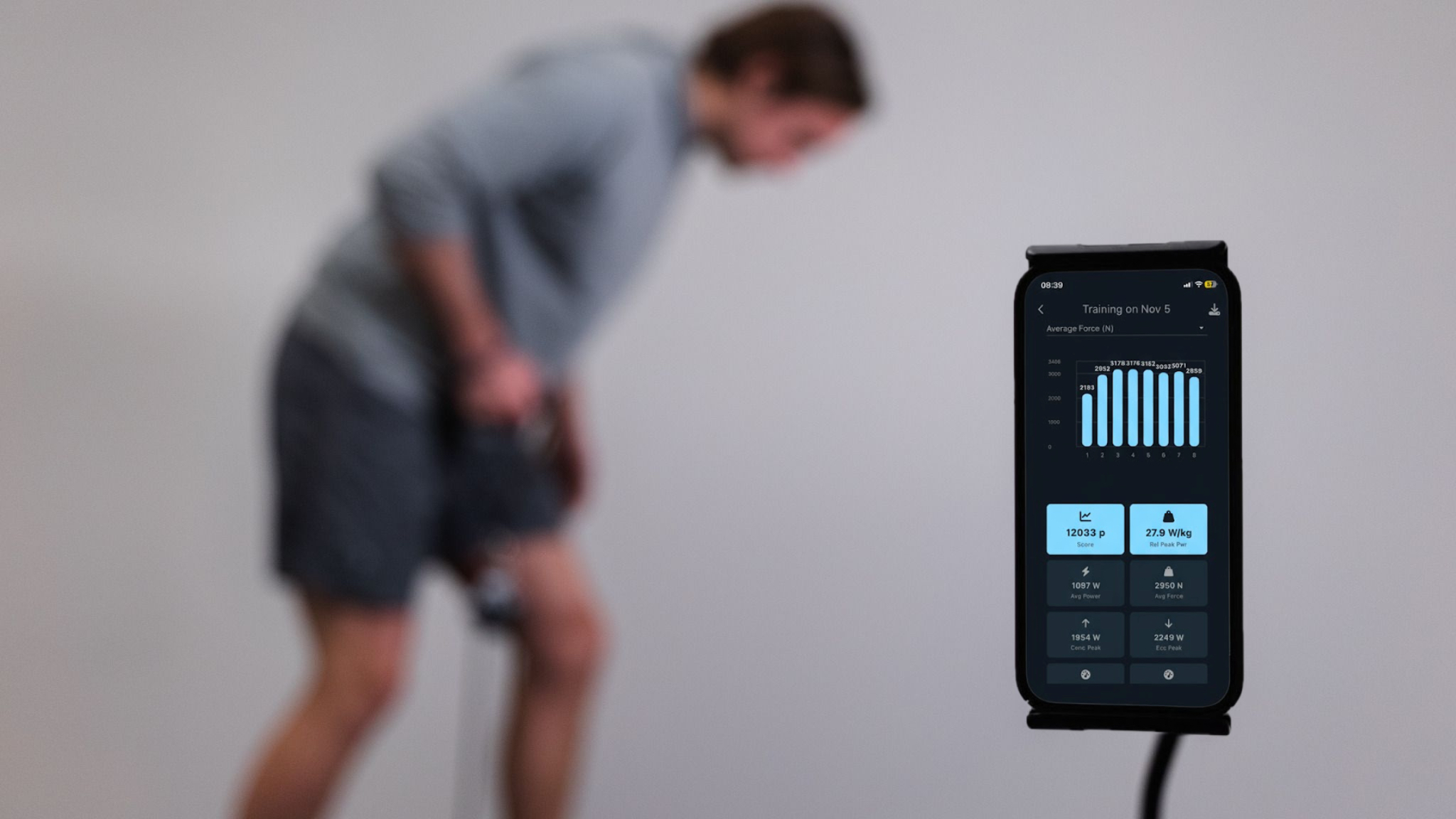
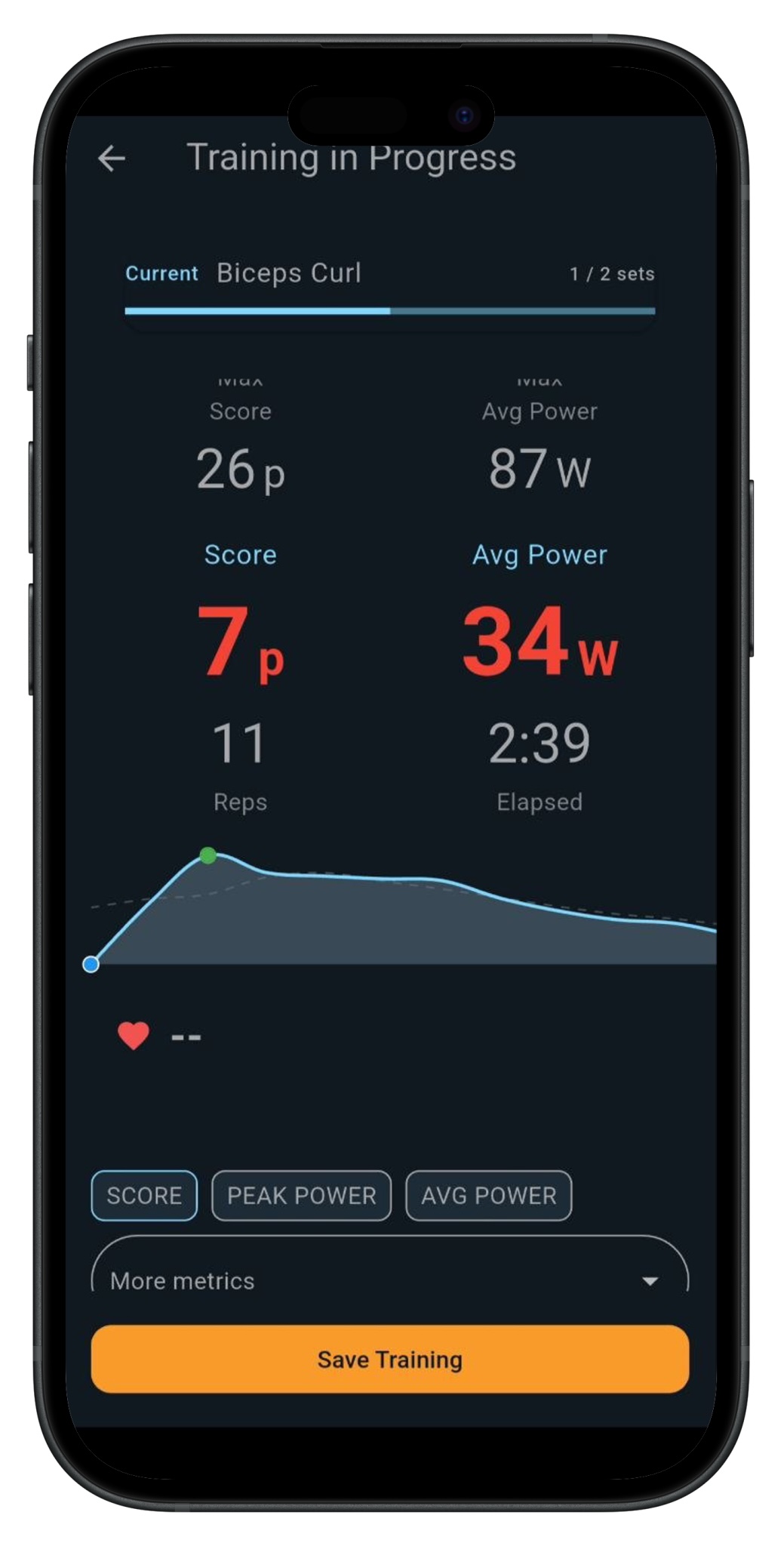
With Exxentric systems such as the kBox and kPulley, users can pair flywheel training with the kMeter and the Exxentric App to monitor performance in real time.
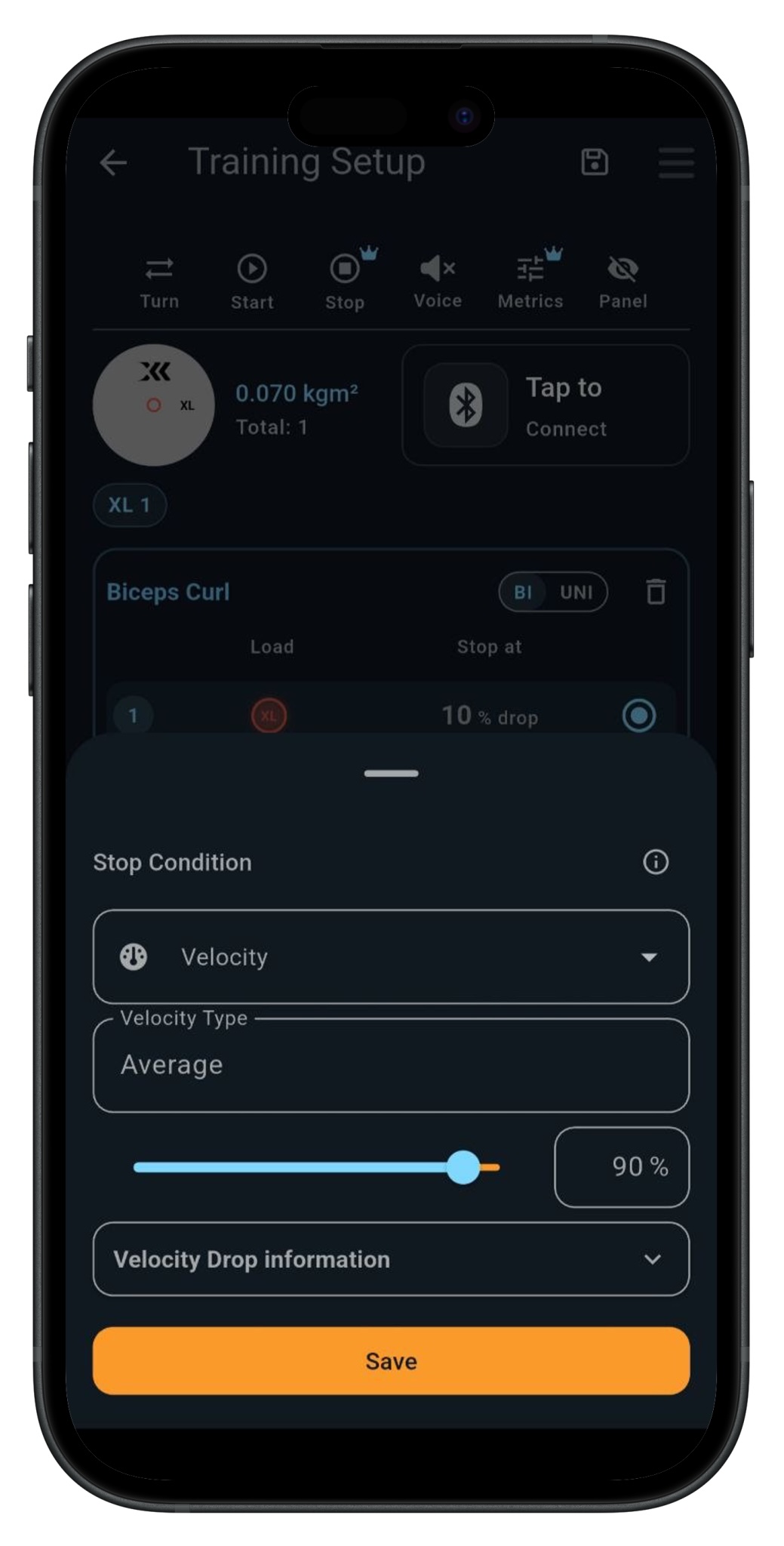
The Exxentric App can help users set velocity-loss and auto-stop conditions so the set ends when the desired drop-off has been reached. This makes the training target easier to repeat and removes much of the guesswork from deciding when enough is enough.
The feature is now available free in the live version of the app, making it easier for more users to apply performance-based stop conditions in everyday training.
Track performance across sessions so your training is built around quality output, not just fatigue.
Train smarter, not just harder
Velocity loss training is not about avoiding hard work. It is about making the work more targeted.
If the goal is power, a large drop-off may mean you are staying in the set too long. If the goal is hypertrophy, a larger drop-off can be exactly the point.
The real value is having a clear stopping rule. Instead of guessing, you can match the threshold to the goal and keep the session focused on the type of adaptation you actually want.
Key takeaways
- Velocity loss measures how much movement speed drops during a set.
- In the referenced squat study, a 20% velocity loss threshold produced similar strength gains to a 40% threshold while requiring substantially less work.
- The study used traditional weight training, so the same threshold should not be copied directly into flywheel training.
- Because flywheel resistance adapts to maximal effort on every rep, 20% velocity loss can already be a large and potentially overly fatiguing drop when training for power.
- For power-focused flywheel training, experimenting around 10% velocity loss is a practical starting point.
- Higher velocity drops, such as around 30%, can still be very effective for hypertrophy, especially with lower total training volume in sets or weekly sessions.
- The kMeter and Exxentric App make velocity-loss and auto-stop conditions easier to use in real training.
Article reference
Referenced study: Pareja-Blanco, F., Rodriguez-Rosell, D., Sanchez-Medina, L., Sanchis-Moysi, J., Dorado, C., Mora-Custodio, R., Yanez-Garcia, J. M., Morales-Alamo, D., Perez-Suarez, I., Calbet, J. A. L., & Gonzalez-Badillo, J. J. (2017). Effects of velocity loss during resistance training on athletic performance, strength gains and muscle adaptations. Scandinavian Journal of Medicine & Science in Sports, 27(7), 724-735. DOI: 10.1111/sms.12678.
Most relevant points: The study compared 20% and 40% velocity loss thresholds during an 8-week squat program. The 20% group produced similar squat strength gains, greater countermovement jump improvement, and completed substantially less total work, while the 40% group showed greater hypertrophy and a reduction in myosin heavy chain IIX percentage.
Use velocity loss and auto-stop conditions in the Exxentric App
The Exxentric App helps make performance-based training easier to apply with the kMeter. Set clear endpoints, track your output, and keep each set aligned with the result you want. You can also explore compatible Exxentric products for flywheel training.