


Basketball Strength Training: Why Deceleration Matters as Much as the First Step
A defender cuts off the lane. A ball-handler brakes before a second drive. A rebounder lands and has to find the next assignment. In each moment, speed only helps if the athlete can absorb force, reorganize and produce the next action without losing time.
That is why deceleration deserves a clearer place in basketball strength training. It is not separate from acceleration. It is the part that makes acceleration repeatable in a sport built from short approaches, sudden stops, lateral cuts and contested landings.
The brake is part of the play
Basketball rarely gives an athlete a clean straight-line effort. A closeout becomes a slide. A drive becomes a stop, plant and second attack. A cut requires the player to lower speed, accept force through one leg and leave at a new angle. A jump is only useful if the landing leaves the athlete ready to play again.
Each sequence combines force production with force absorption and redirection. The strength question therefore has two parts: can the athlete create force into the floor, and can the athlete control the force coming back before the next decision?
What the basketball evidence can and cannot say
The most direct review is also the most useful starting point. A 2023 systematic review of eccentric-overload training in basketball found seven eligible studies involving 203 players. All seven measured countermovement jump performance, while five also included sprinting and change-of-direction tests. The review reported improvements in basketball-related performance measures, but it also stressed that the evidence base was small and more research was needed.
A 2026 meta-analysis of 13 studies involving 324 team-sport athletes found greater improvements than conventional resistance training for power and the T-test measure of agility. It found no significant between-method difference for strength or 10 m and 20 m sprint performance. A separate 2026 review focused on change of direction found a significant improvement after Flywheel Training compared with control interventions.
The practical conclusion is measured and useful: Flywheel Training can support basketball strength and power development, including the physical qualities behind change of direction. The exercise, inertia, intent, athlete and wider programme still determine what is trained and what can transfer.
Why Flywheel Training fits the braking problem
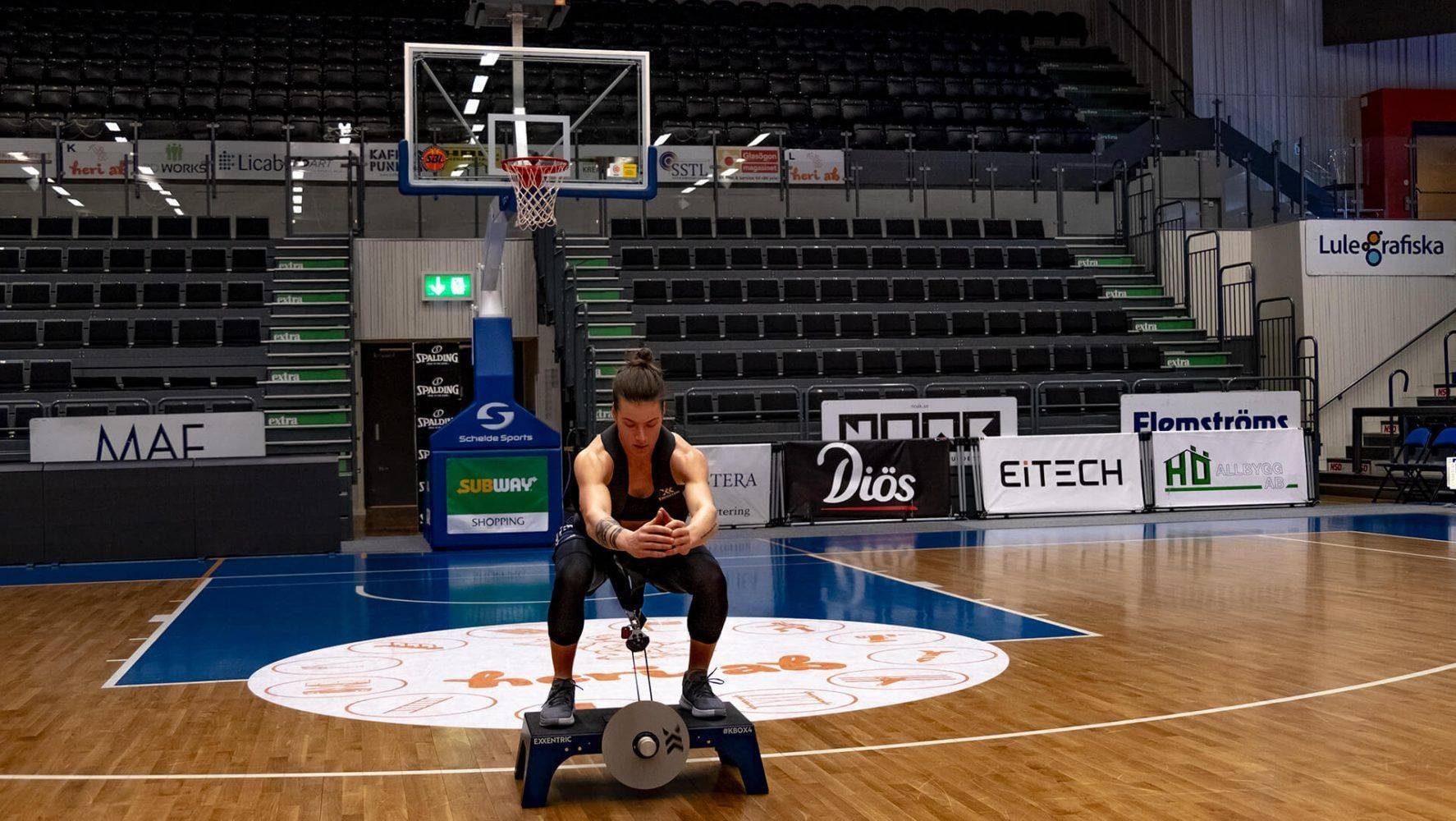
In Flywheel Training, the athlete accelerates a rotating flywheel during the concentric phase. The stored energy returns through the belt or cable and must be controlled during the lengthening phase. The repetition therefore includes both the force used to create movement and the force used to manage the return.
The kBox is a natural fit for lower-body work such as squats, split squats and lateral squat variations. The kPulley adds adjustable angles for pulling, pressing and rotational work. These are options for building the physical qualities behind basketball actions, not claims that a machine reproduces the sport.
Eccentric overload needs a method
The return phase is not automatically eccentric overload. Flywheel Training makes eccentric emphasis possible, but true eccentric overload means that eccentric demand exceeds the athlete’s maximal concentric output. Exxentric’s current guidance on eccentric-overload methods describes several ways to create that condition on a kBox.
A coach may want smooth braking and repeatable force absorption in one context, and a more demanding overload method in another. The method should follow the training objective, the athlete’s experience and the rest of the programme. The equipment label alone does not tell you what the athlete achieved.
Use the next basketball question to choose the emphasis
A useful basketball strength session starts with a named problem. Is the athlete losing position when stopping from a closeout? Struggling to hold a single-leg plant before a second effort? Producing force well but failing to control the landing? The answer should guide exercise selection and the way progress is judged.
The Exxentric exercise library gives coaches current movement options across kBox, kPulley and SingleExx, with filters for body area and sport. Use it to inspect the movement itself, then relate the exercise to the quality that needs attention.
The first step is only half the play
Basketball strength training should develop both sides of the sequence: the force to accelerate and the control to absorb, redirect and go again.
Flywheel Training earns a place in that conversation because each repetition asks the athlete to create rotational energy and manage its return. With the right exercise and a clearly defined objective, a kBox or kPulley can help coaches train the physical qualities behind braking and re-acceleration without pretending to replace basketball practice.
Explore basketball-relevant movement options
Browse the Exxentric exercise library to find current kBox and kPulley movement options for basketball-relevant strength and power work.
Team-sport comparison: Eidiyan-Kakhki, M. M., Rajabi, H., Amani-Shalamzari, S., Motamedi, P., Jafari, M., and Nikolaidis, P. T. (2026). A Comprehensive Systematic Review and Meta-Analysis of Isoinertial Flywheel vs. Traditional Resistance Training on Strength, Power, Speed, and Agility in Team Sports. Research Quarterly for Exercise and Sport. DOI: 10.1080/02701367.2026.2662550.
Change-of-direction meta-analysis: Zhang, J., Mi, J., and Liu, R. (2026). Effect of Flywheel Resistance Training on Change of Direction Performance in Team Sports: A Systematic Review and Meta-Analysis. Medicine, 105(18), e48524. DOI: 10.1097/MD.0000000000048524.
