


Our History. Because Strength Matters.
From a coaching challenge to a new approach to strength training. Discover the people, research and ideas behind Exxentric.
One Belief. Making People Stronger.
The goal has remained the same since Exxentric was founded in 2011: to build devices that help people become stronger and have the strength they desire.
Strength matters beyond performance. It helps us endure, succeed and meet the demands of everyday life. That belief continues to guide the tools and methods we develop.
“Because strength matters, in all parts of life.”
Fredrik Correa, M.D.
Co-founder of Exxentric

From an Idea. To Exxentric.
2001–2011
A coaching challenge sparks an idea
Working at the same ice hockey club, Fredrik Correa and Mårten Fredriksson saw a gap between their junior players’ athletic potential and their lifting technique. They began exploring how flywheel resistance could help athletes train effectively.
2011
Exxentric is born
Combining their training experience with Kjell Insulander’s engineering skills, the founders launched Exxentric and released the kBox 1.0. The company’s journey began on February 23, 2011.
2021
Ten strong years
Exxentric marked a decade of development. Flywheel devices were being used in professional sports, rehabilitation, health and fitness, and home training, supported by a growing network of partners and customers.
2024
Thirteen years of development
By its thirteenth anniversary, Exxentric had grown from a small team with a single prototype into an international flywheel training business. The original purpose remained: helping people become stronger.
A Century of Ideas. The Origins of Flywheel Training.
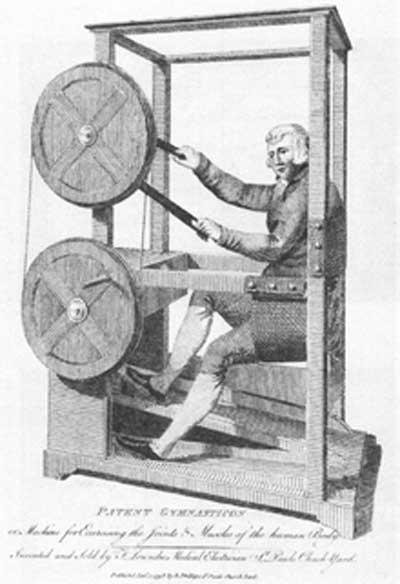
Early experiments
Flywheel exercise devices long predate Exxentric. The Gymnasticon, invented by Francis Lowndes in 1796, is an early documented example.
In 1913, August Krogh described a bicycle ergometer using a flywheel for resistance (2). In 1924, Hansen and Lindhard at the University of Copenhagen used a lead-and-steel flywheel to investigate force during biceps contraction (1).
Strength Training in Space
Interest in flywheel resistance returned in the late 1980s as researchers explored ways to address muscle atrophy and bone loss during space travel. Because flywheel resistance relies on inertia, it offered a way to train independently of gravity.
Scientists at Karolinska Institutet in Stockholm developed flywheel devices with support from ESA, NASA and the Swedish National Space Board. A 1994 study described a gravity-independent leg-extension ergometer for resistance training in space (3).
A Practical Problem. A Different Way to Train.
From the ice rink to the laboratory
Fredrik Correa and Mårten Fredriksson met while studying at the Swedish School of Health and Sport Sciences. Later, they coached different age groups at the same ice hockey club.
Their young players were strong and talented, but many had little experience with free weights. Too much of their junior development was spent learning to lift, limiting the training load the coaches could use.
While working on research projects at Karolinska Institutet, Fredrik encountered a prototype built by engineer and speed skater Håkan Eriksson. A flywheel and shaft mounted on a small plate allowed Håkan to perform repeated half squats for off-ice training.
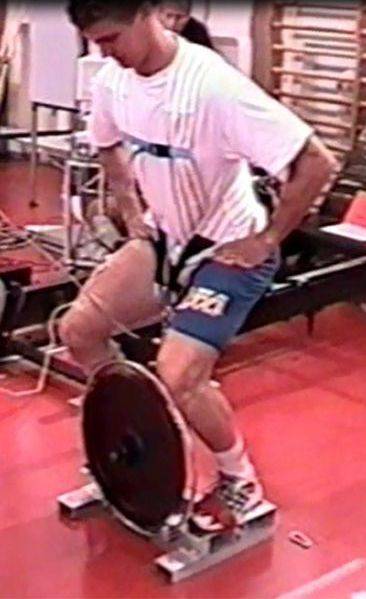
Building a multi-exercise device
Fredrik and Mårten saw the potential to develop the prototype into a device with more freedom of movement. They wanted the versatility of free weights, using a flywheel for resistance.
They increased the height of the box to allow deeper squats, enlarged the platform for lateral movements and extended the shaft to accommodate more flywheels.
Learning from the first release
Developing the prototype took far more work than expected. It functioned, but the founders still saw room for improvement when the research leader’s company released it onto the market.
Feedback from users confirmed many of their own ideas and introduced new ones. The experience laid the groundwork for the next stage of development.
2011. The Beginning of Exxentric.
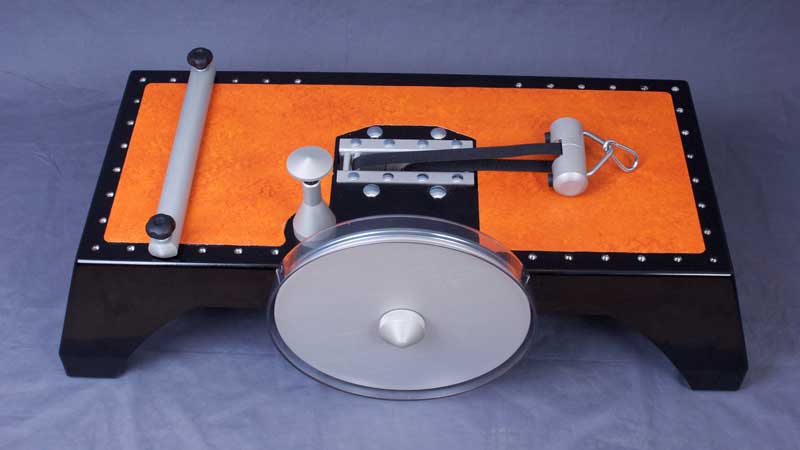
Turning experience into the kBox
After leaving the research laboratory, Fredrik completed medical school at Karolinska Institutet in 2006. He and Mårten continued discussing how their ideas could better serve athletes and patients.
Meeting Kjell Insulander, a producer and subcontractor of metal parts with an interest in training, brought the engineering expertise needed to move forward. Together, they launched Exxentric and released the kBox 1.0 in 2011.
Later generations of the kBox, expansion into the United States, the kPulley and the kMeter feedback system marked further steps in the company’s development.
The Story Continues. Find Your Stronger Self.
References
1. Hansen T.E., Lindhard J. On the maximal work of human muscles especially the flexors of the elbow. 1924. Laboratory for the Physiology of Gymnastics, University of Copenhagen.
2. Krogh A. A bicycle ergometer and respiration apparatus for the experimental study of muscle work. Skand. Arch. Physiol. 1913;33:375–395.
3. Berg H.E., Tesch A. A gravity-independent ergometer to be used for resistance training in space. Aviat Space Environ Med. 1994 Aug;65(8):752–756.
Adapted from the history shared by Fredrik Correa, M.D., co-founder of Exxentric. Another version was published on the Freelap USA blog. Read more.