Flywheel Training for Tennis Performance
Executive summary
Tennis practice develops strokes, decisions, and tactics. Physical preparation develops the body that has to deliver them. Flywheel Training for tennis performance can train lateral force, braking, reacceleration, rotation, and upper-limb capacity within one connected method. For recreational players, that can mean less scrambling and better-quality movement throughout a session. For competitive players, coaches, clubs, and academies, it creates a practical way to build and measure physical qualities that support stronger tennis.
Watch the upcoming US Open closely and resist the obvious temptation. Do not follow only the ball.
Watch the player who has just struck it.
Before the opponent makes contact, that player has to control momentum, reverse direction, move toward the appropriate recovery position, and prepare to react again. The professionals do it at extraordinary speed, but the movement problem is familiar on every court. The player who recovers well makes the next ball easier to reach. The player being pulled from side to side spends more of the rally repairing position.
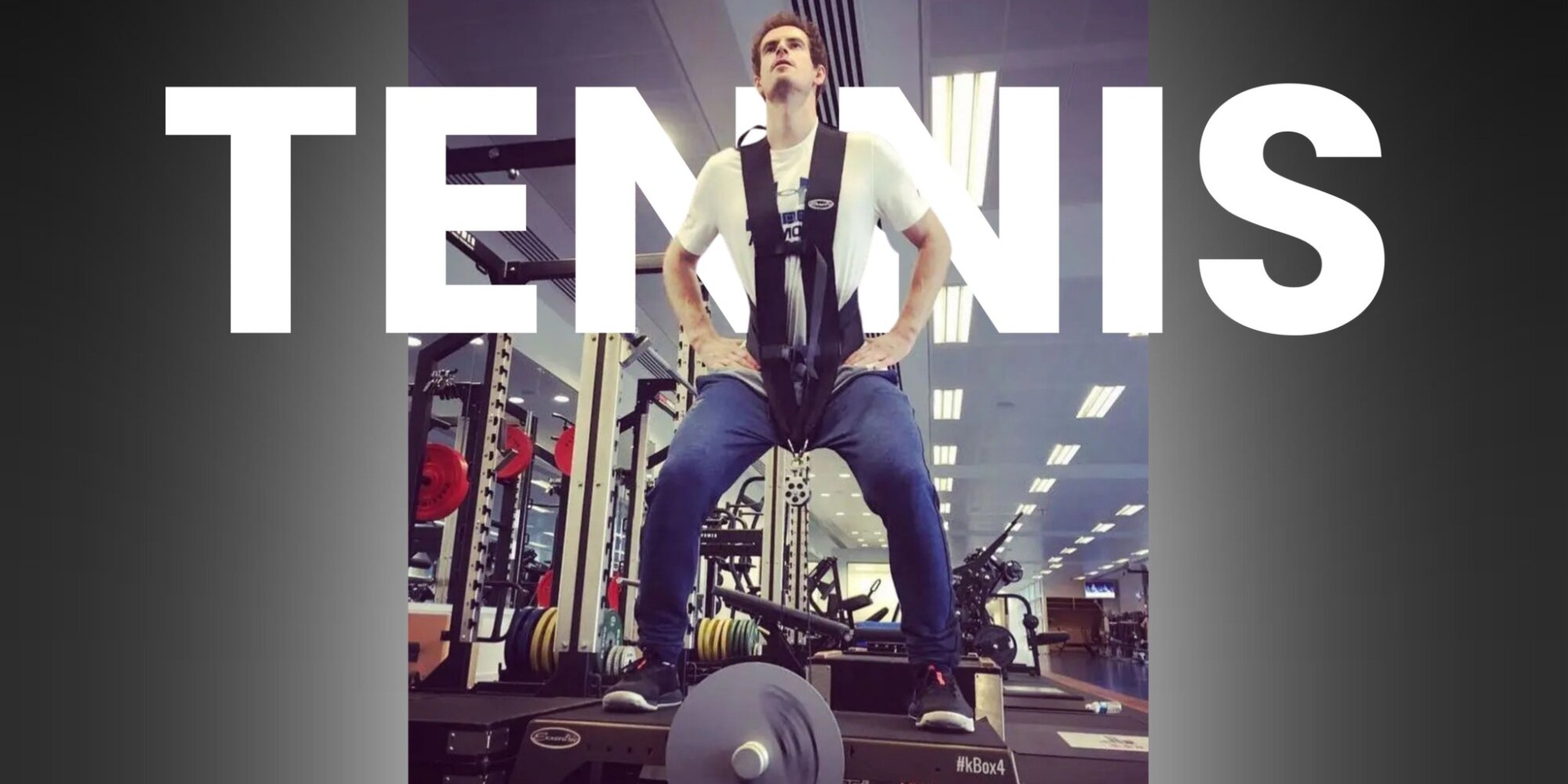
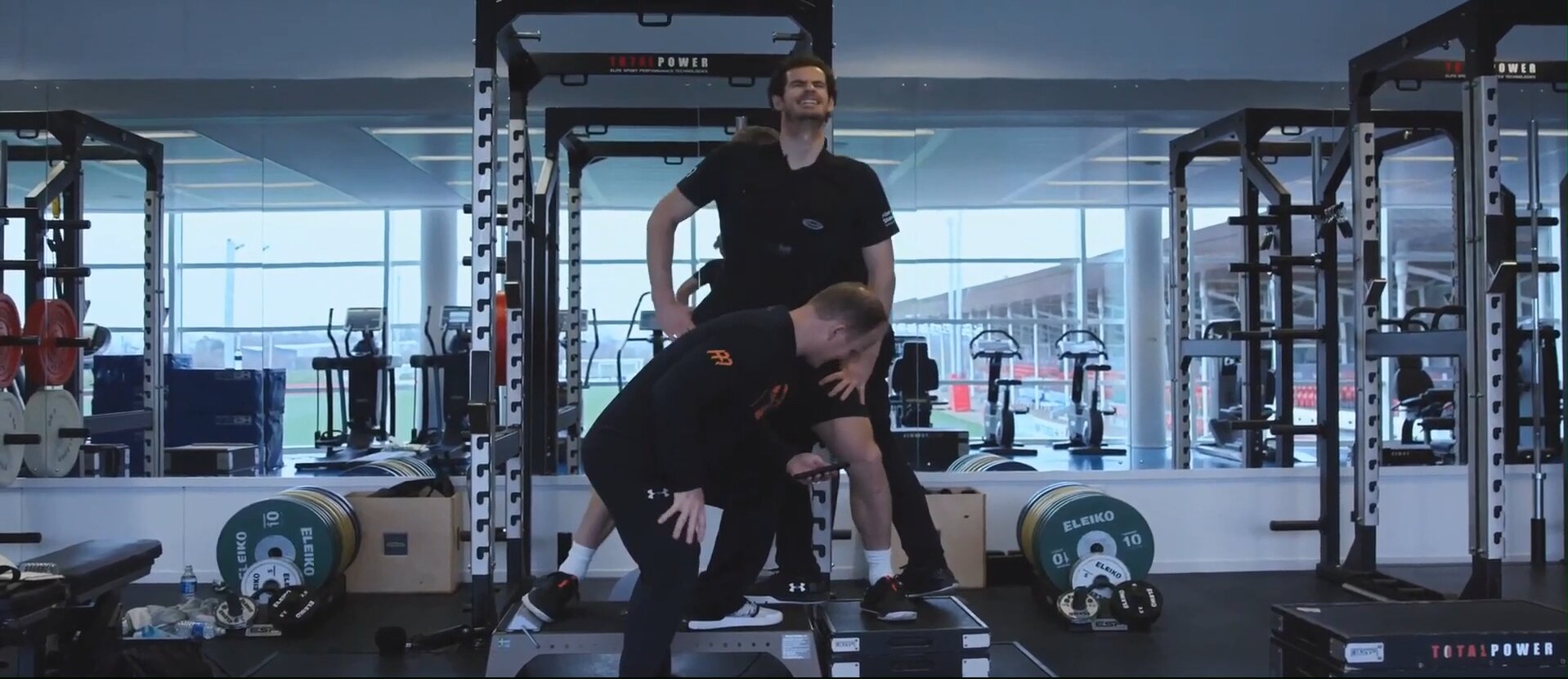 Andy Murray (US Open 2012, Wimbledon 2013 & 2016) training lateral squats on the kBox
The point continues after contact
The 2026 US Open singles main draw begins on August 30. Across the hard courts in New York, explosive serves and spectacular winners will command attention. Yet much of the physical contest will unfold in quieter moments: the brake after a wide forehand, the first step out of the corner, and the recovery that gives the player access to the next ball.
Tracking from professional Grand Slam tennis recorded approximately 1.6 changes of direction per point. Men changed direction about every 2.7 seconds and women about every 3.1 seconds. Around two-thirds of the identified changes exceeded 105 degrees.
That is not a straight-line speed problem. It is a repeated force-management problem. Players have to arrive, absorb load, reverse direction, and produce force again. The correct recovery point changes with court geometry, shot selection, and likely reply angles. Tennis coaching teaches that decision. Strength and conditioning give the player more physical capacity to execute it.
Why Flywheel Training fits the movement between shots
On the kBox or kPulley, the player accelerates a flywheel and then manages the energy that returns. Every repetition therefore contains force production and force absorption.
That does not make a flywheel exercise a tennis stroke or footwork drill. It makes it a powerful way to prepare the physical qualities underneath tennis movement: producing force, controlling force, and changing from one to the other without losing position.
Being in position makes tennis easier
Reaching a difficult ball is impressive. Reaching the next one starts with what happened after the previous strike.
A player who recovers efficiently has more time to split step, read the opponent, and organize the body. A player who remains outside the best recovery zone may need a faster sprint, a more defensive swing, or another emergency movement just to stay in the rally.
This does not mean the match winner always covers less total distance. Research comparing winners and losers is mixed, and playing style changes the movement profile. The stronger claim is simpler: better positioning can reduce unnecessary movement and give the player a better starting point for the next action.
Movement efficiency becomes tactical pressure
When one player keeps recovering into useful positions, the opponent has to do more to create open space. When one player is repeatedly late, each shot can pull them farther from control of the court.
Physical preparation cannot choose the correct recovery position. It can help the player brake sooner, push away from the edge of the court, and arrive with enough control to use the tactical decision their coach has trained.
Four physical qualities behind better tennis
The strongest programme does not chase every benefit with a different machine. It connects a small number of important qualities to clear tennis applications.
What to watch at the 2026 US Open
When the main draw starts, look beyond the winner at the end of the rally. Watch the movement that made the next shot possible.
- After a wide groundstroke: How quickly does the player stop travelling outward and begin recovering?
- After the serve: Can the player land, regain balance, and establish a position for the return?
- During longer exchanges: Who keeps arriving ready, and who is spending extra steps repairing position?
- Under pressure: Can the player still brake, redirect, and organize the next movement cleanly?
The speed is different from recreational tennis. The principle is not. Finish the shot, recover, and prepare to play again.
Build the legs that reclaim the court
The kBox lateral squat puts force production and force absorption into the frontal plane. With the Foot Block, the player can work from a stable lateral position and direct force through the working leg.
The exercise has a specific physical job. Drive out of the lateral position, control the flywheel’s return, and finish balanced enough to reverse the action again. That connects lower-body strength to the same broad produce-brake-redirect sequence seen around the court.
Split squats, single-leg patterns, and hinges add unilateral strength and hip control. The aim is not to imitate tennis footwork under load. It is to give the player stronger physical options when real footwork becomes fast, reactive, and unpredictable.
Power should travel through the whole player
Serve speed and groundstroke power are not created by the wrist alone. Tennis uses a linked kinetic chain involving the legs, hips, trunk, shoulder, forearm, wrist, and racket.
The kPulley, combined with the Rotational Sling, can load rotation through the torso while letting the player produce and control force from a stable stance. Split-stance rotations, standing core twists, and rotational pulls can develop trunk strength and coordination without pretending to be resisted forehands.
The distinction matters. Tennis practice teaches stroke timing and racket mechanics. The gym builds the force-transfer capacity that supports those trained movements.
A stable racket arm still has to move freely
Upper-limb strength should not make the tennis stroke rigid. The shoulder, upper arm, forearm, and wrist need enough capacity to accelerate, guide, and decelerate the racket repeatedly while remaining part of the full kinetic chain.
kPulley external rotation, single-arm rows, single-arm presses, and controlled forearm work can help build strength around the shoulder and racket arm. The load should remain appropriate to the player, the range should be comfortable, and the return should stay controlled.
This is physical preparation, not treatment. Players with pain or a history of upper-limb injury need individual assessment and exercise guidance from a qualified clinician.
Keep playing well for the whole session
Not every tennis player is preparing for a five-set match. Many want to move better and enjoy stronger tennis for one or two hours. The physical requirement still matters.
Match-play research has observed reductions in repeated-sprint ability, change-of-direction performance, leg stiffness, and upper-limb output under fatigue. Responses vary between players and competitive settings, but the training objective remains clear: build enough capacity to maintain useful movement and stroke-supporting strength for as long as your tennis demands.
For a recreational player, that may mean finishing a club session without every wide ball becoming a scramble. For a competitive player, it may mean retaining movement quality deep into a difficult match. The level changes. The value of physical preparation does not.
How to use Flywheel Training for tennis performance
Most players do not need large amounts of gym volume. One or two focused sessions can provide a practical starting point that complements court work.
Session A: lateral force and recovery
- kBox lateral squat: 3 sets of 5-8 repetitions per side.
- kBox split squat: 3 sets of 5-8 repetitions per side.
- kBox Romanian deadlift: 2-3 sets of 6-8 controlled repetitions.
Session B: rotation and racket-arm capacity
- kPulley Rotational Sling rotation: 3 sets of 5-8 repetitions per side.
- kPulley single-arm row or press: 3 sets of 6-8 repetitions per side.
- kPulley external rotation: 2-3 sets of 8-12 repetitions per side.
- Light forearm or wrist work: 2 sets of 10-15 smooth repetitions.
Start with manageable inertia and learn to control the returning energy. Progress output, range, or inertia one variable at a time. Place demanding lower-body work away from important matches or intense court sessions, and reduce volume during competition periods.
Why serious tennis preparation needs more than court time
Court practice is irreplaceable. It develops strokes, anticipation, decision-making, and tactical awareness. But the court is not always the best place to build every physical quality supporting those skills.
This is where Exxentric systems become a compelling investment. The kBox gives players and coaches a platform for lower-body strength, unilateral work, and lateral force control. The kPulley adds horizontal and rotational loading alongside upper-body training. Resistance adapts to the athlete’s effort, making the same training environment useful across different strength levels.
Instead of treating lateral strength, rotation, braking, and upper-body capacity as disconnected jobs, a connected Exxentric setup brings them into one training system. For an individual player, that means more ways to prepare beyond the court. For a coach, club, or academy, it means one platform can support multiple players, exercises, goals, and stages of development.
The Investment Case for Tennis
|
Who It Serves
|
What They Need
|
Why Exxentric Fits
|
|---|---|---|
|
Recreational players
Better movement
|
Accessible progression
Strength beyond court time
|
Adaptive loading
Many exercises, clear progression
|
|
Competitive players
Performance preparation
|
Power plus control
Measurable physical qualities
|
High training ceiling
Strength, speed, and eccentric work
|
|
Coaches
Individualised programming
|
Different players and goals
One connected method
|
Broad exercise choice
Progressive, effort-led resistance
|
|
Clubs and academies
A stronger performance offer
|
Versatile equipment
Development to performance
|
More value from the space
One setup, many applications
|
The missing piece is often between the shots
A new racket cannot recover your court position. More technical practice cannot always solve a physical braking deficit. General strength helps, but it may not expose the player to the rapid produce-and-absorb cycle that makes Flywheel Training distinctive.
If tennis matters enough to invest in coaching, court time, competition, and equipment, the body delivering every shot deserves the same attention. Exxentric systems give players and tennis organisations a serious way to build that physical layer.
Start with the movements that matter
Explore lateral, unilateral, rotational, and upper-body exercises, then build sessions around the player rather than forcing the player into a generic programme.
The bottom line
The next ball does not begin when your opponent strikes it. It begins when you finish your own shot.
Flywheel Training for tennis performance gives players a way to strengthen what happens in that space: brake, redirect, recover, rotate, and prepare to produce force again. It will not replace tennis coaching, court time, or tactical practice. It makes the physical preparation behind them more complete. For players who want better movement and for organisations serious about developing tennis performance, that is not an optional extra. It is part of building the complete player.
Key takeaways
- Recovery begins immediately after contact and influences how accessible the next ball becomes.
- Flywheel Training can develop lateral force, braking, redirection, rotation, and upper-limb capacity.
- The kBox is particularly useful for lower-body, unilateral, and lateral strength work.
- The kPulley expands training into rotational and upper-body patterns relevant to tennis preparation.
- Recreational and competitive players share the same broad movement needs, even when speed and match duration differ.
- Direct tennis-specific flywheel research is limited. The strongest recovery and change-of-direction case combines broader flywheel evidence with established tennis match demands.
Build the body behind better tennis
Explore Exxentric systems for your training, club, or academy, or talk to an Exxentric expert about building a tennis performance setup.
Research referencesProfessional movement demands: Giles, B., Peeling, P., & Reid, M. (2024). Evidence note: Tennis research directly supports the importance of multidirectional movement, physical training, and repeated performance. Flywheel evidence supports change-of-direction development in broader athletic populations. The small tennis-specific flywheel study reported improved serve velocity within the training group, but its group-by-time interaction was not significant. The recovery applications in this article are therefore an evidence-informed training rationale rather than direct proof of improved tennis match outcomes.