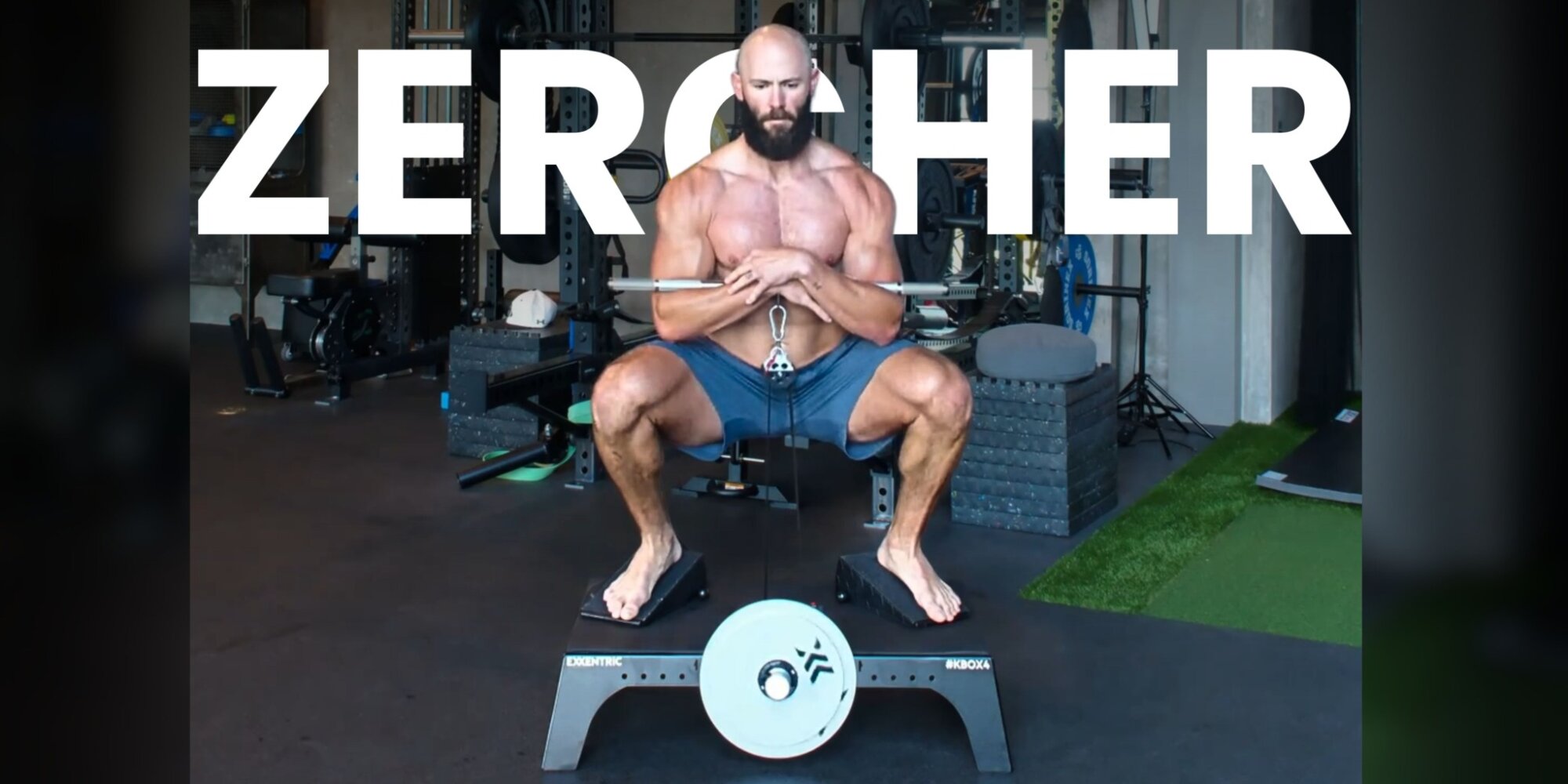
A Case for the Zercher
Stop the movement and one thing stands out: they’re all in a Zercher position.
Executive summary
The Zercher position deserves more attention in performance training. It naturally teaches anterior-chain stiffness, trunk integrity, upper-back involvement, and coordinated force transfer with the load in front of the body. That makes it highly relevant for contact and combat sports, where athletes rarely express force with a bar balanced across the back. Flywheel resistance strengthens the case further by giving the athlete variable resistance, more freedom in joint strategy, better eccentric loading, and cleaner options for added shrugs, twists, and throw-like finishes.
Zercher squats, Zercher deadlifts, Zercher good mornings / RDL variations offer something many athletes need more of: front-loaded strength that looks and feels closer to the demands of carrying, bracing, colliding, wrestling for position, and producing force with the load in front of the body.
When these movements are performed on Exxentric systems, Flywheel Training makes the pattern even more useful by matching resistance to intent, expanding the range of viable movement outcomes, and making rotational or explosive variations far easier to train well.
Why the Zercher pattern matters
The Zercher position is often treated like a specialty lift, but that undersells what it offers. It places the load in front of the athlete, forces the trunk to organize around that front-loaded demand, and asks the upper back, hips, and legs to contribute together.
In practical terms, that means the athlete is not just moving a load. They are managing position while the load tries to pull them forward.
That matters in sport. In contact and combat settings, athletes frequently need to absorb force, keep posture, and keep producing force while an opponent, implement, or awkward load is trying to break structure.
You never back squat a couch
That line is memorable because it points to something useful. Many demanding real-world tasks are front-loaded. You pick up a sandbag, carry a person, control an opponent, wrestle for body position, or brace against impact with the load in front of you, not neatly stacked across the upper back.
The Zercher pattern is not valuable because it imitates a couch exactly. It is valuable because it puts the athlete into a more realistic front-loaded constraint, where posture, bracing, and force transfer have to work together under pressure.
Why this matters for combat and contact sports
Athletes in collision sports are rarely tested by clean, symmetrical positions alone. They are tested by imperfect leverage, disrupted posture, and the need to keep producing force anyway.
That is one reason Zercher variations can carry over so well. The position reinforces the ability to stay stacked while the load lives in front, which has obvious relevance for scrums, tackles, clinches, lifts, sprawls, pummeling, and forceful changes in body position.
Even outside of direct collision, the pattern teaches athletes to connect legs, trunk, and upper body in a way that feels closer to applied sport force than many purely back-loaded lifts.

Accessible learning curve with less mobility friction
Another advantage is accessibility. Many athletes can find a usable Zercher squat or Zercher hinge pattern faster than they can earn a technically solid front squat or a comfortable back squat position.
The athlete does not need the same shoulder external rotation, wrist extension, thoracic extension, or rack-position tolerance. In many cases, that means less coaching time spent solving setup problems and more time spent training the actual quality you wanted in the first place.
Where Zercher variations tend to shine
The Zercher family is not automatically better than every other lift. The value is that it solves a different problem. It is often a better fit when the goal is force transfer with a front-loaded demand, not just moving the biggest possible load in the most mechanically efficient position.
Why flywheel makes the Zercher pattern even better
The case for Zercher movements gets stronger once the load comes from a flywheel instead of a barbell.
With traditional weights, the athlete still has to respect the fixed path demands of a free bar. The bar wants to stay balanced over mid-foot, and in a Zercher position that can limit how far you can explore different torso angles, force directions, and finish strategies without the lift simply turning awkward.
Flywheel resistance changes that. The athlete is connected to the load through a tether, not pinned to a bar path. That gives you a front-loaded pattern without the same mechanical compromises.
The practical shift
On a flywheel, the load matches what the athlete creates. Push harder and the returning demand increases. Stay smooth and organized and the pattern stays clean. That makes the Zercher position easier to scale across different athletes and more specific to the unpredictable force demands seen in contact sport.
Variable resistance is a natural fit for contact athletes
Combat and contact sports do not happen against a perfectly fixed external load. Force rises, drops, redirects, and changes with the opponent, the collision, and the moment.
That is why flywheel resistance fits so well here. It is responsive. The athlete is not handed one fixed load to survive. Instead, the system gives back what the athlete put in, which means the stimulus can better reflect real sporting actions that are forceful but not perfectly uniform.
For coaches, that creates a highly useful middle ground: enough loading to build force, enough freedom to keep it athletic, and enough eccentric demand to make the braking phase count.
No rolling bar. No forced bar path.
Two practical benefits matter immediately. First, there is no bar trying to roll out of the elbows as fatigue builds or torso angle changes. Second, the athlete no longer has to keep a straight bar balanced over mid-foot through every inch of the movement.
That freedom is not just about comfort. It expands what you can train. A Zercher squat can become more upright, more hinged, more driving, or more elastic. A Zercher RDL can emphasize posture, reach, recoil, or aggressive hip extension without the same technical trade-offs a barbell creates.
More outcomes from the same setup
Once the movement is no longer trapped inside a strict bar path, the Zercher position becomes a base for more than just squatting and hinging.
You can finish with a shrug. You can layer in controlled rotation. You can bias a diagonal drive. You can even progress toward throw-like actions where force is projected and then rapidly decelerated by the system.
That is especially valuable in sports where strength rarely stays purely vertical. Athletes need to express force through awkward lines, partial rotations, and dynamic contacts, and flywheel resistance lets the coach train those outcomes without abandoning meaningful load.
Why Exxentric systems fit the Zercher family so well
With kBox and kPulley, coaches can keep the front-loaded logic of the Zercher position while gaining the self-regulating resistance and eccentric demand that make flywheel training so effective. Include a Decline Board for enhanced variation and the knurled kBar for very strong athletes.
That combination is especially compelling for teams and performance environments that want strength work to look less like isolated lifting practice and more like transferable force production under realistic constraints.
What this can look like in practice
A Zercher squat on a kBox can emphasize leg drive, trunk control, and braking strength. A Zercher deadlift can train front-loaded force production from the floor without forcing a rigid bar track. A Zercher good morning or RDL can expose whether the athlete can keep posture while hinging hard.
Then the coach can build from there. Add a shrug. Add a rotational finish. Change stance width. Bias a split position. Shift from controlled strength to more ballistic intent.
Instead of treating the Zercher as one niche barbell lift, flywheel training turns it into a broader movement family with clear value for athletic development.
Sample Zercher-focused program
Here is one practical way to organize a Zercher-focused flywheel session when the goal is to combine explosive intent, full-range strength, and front-loaded unilateral control.
This sequence moves from high-intent force production into fuller-range strength work, then finishes with a staggered-stance variation that challenges control and side-to-side organization under front-loaded demand.
The bottom line
The Zercher is worth revisiting because it asks athletes to solve a more transferable problem. Instead of organizing strength around a load that sits comfortably on the back, it asks them to produce force while managing a demanding front-loaded position.
That already makes the movement family useful for combat and contact sports, for athletes with limited mobility, and for coaches who want a shorter path from setup to productive work.
On Exxentric systems, the case gets even stronger. Flywheel resistance removes the most awkward parts of the traditional setup, matches loading to athlete intent, and opens the door to more athletic finishes like shrugs, twists, and throw-like actions. The result is not just a better Zercher. It is a broader front-loaded training category with real value for performance.
Key takeaways
- Zercher movements train front-loaded strength that can carry over well to contact, combat, and other real-world force demands.
- The pattern reinforces trunk stiffness, upper-back contribution, and force transfer while resisting torso collapse.
- Many athletes can learn Zercher variations faster and perform them with fewer mobility limitations than front- or back-loaded barbell options.
- Flywheel resistance makes the movement more self-scaling by matching the returning load to the athlete’s own effort.
- Without a rolling bar or a fixed mid-foot bar path, coaches can explore a wider range of athletic outcomes.
- Flywheel Zercher variations make it easier to add shrugs, twists, and throw-like actions while keeping meaningful load in the pattern.
Build stronger front-loaded training with flywheel resistance
Explore how Exxentric systems can help coaches turn Zercher squats, hinges, and rotational patterns into more transferable strength work for real sport performance.
Programming noteBest fit: Zercher flywheel variations are especially useful when the goal is to build front-loaded force production, bracing capacity, and eccentric control without getting trapped by the mobility or bar-path demands of more traditional setups.
Good starting options: Zercher squat, Zercher deadlift, Zercher good morning, Zercher RDL, and progressed variations that finish with a shrug, rotation, or projected drive depending on the sport demand.