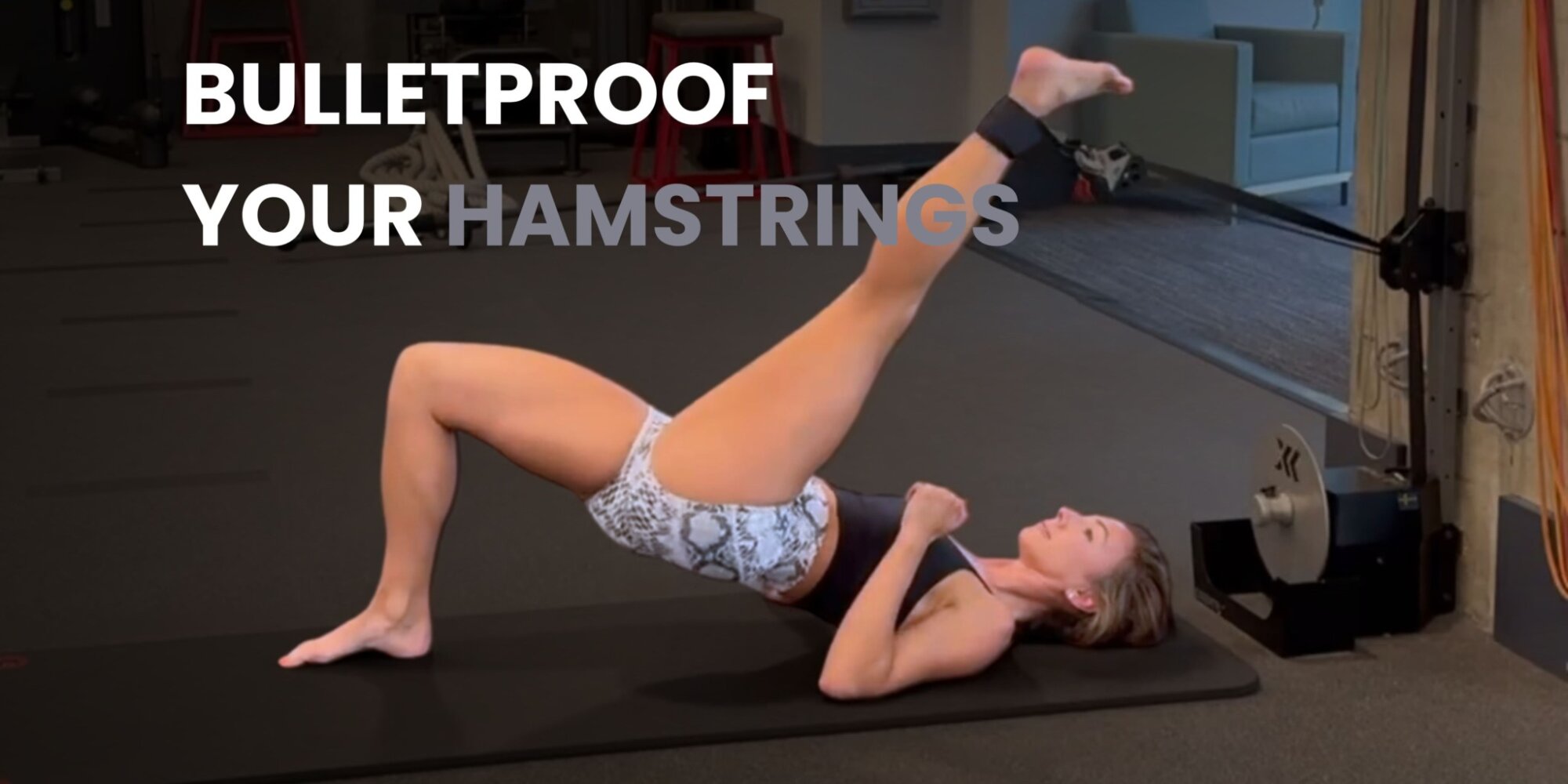
Bulletproof Your Hamstrings: Why the Flywheel Hip Extension Belongs in Performance and Rehab Training
Executive summary
Hamstring strain injuries are common in running-based sports because the hamstrings must absorb high eccentric forces, especially during sprinting. A 2026 article in Strength & Conditioning Journal highlights the flywheel hip extension as a targeted way to load the hamstrings through hip extension, with particular relevance for the biceps femoris long head. The method can support fascicle-length adaptations, eccentric power development, and progressive late-stage rehabilitation when it is programmed with the right intent, volume, and inertia.
Prefer to listen?
This short audio discussion walks you through the main idea behind the flywheel hip extension: why hip-dominant hamstring loading matters, how eccentric control supports sprinting demands, and where the exercise can fit in performance or rehabilitation work.
Audio length: approximately 6 minutes 26 seconds. Listen first for the quick overview, then use the article below for the full breakdown, programming notes, and research context.
Hamstrings rarely fail because an athlete lacks general effort in the weight room.
They fail when the demands of sport exceed what the tissue can tolerate at speed. Sprinting, accelerating, braking, and reaching top velocity all ask the hamstrings to lengthen and produce or absorb force under pressure. That combination is exactly why hamstring strain injuries can be so stubborn: the athlete does not only need strength. They need strength that can be expressed and controlled in fast, hip-dominant movement.
That is where the flywheel hip extension becomes interesting. It gives practitioners a way to train the hamstrings through a movement pattern that is closer to sprinting mechanics than many traditional isolated hamstring exercises, while still allowing the load to be controlled and progressed.
Why hamstring training needs to respect the hip
The hamstrings are often discussed as knee flexors, which is why exercises like leg curls and Nordic hamstring variations receive so much attention. Those exercises can be valuable, but they do not tell the whole story.
During high-speed running, the hamstrings also act as powerful hip extensors. In the late swing phase of sprinting, they help decelerate the lower leg before ground contact. The biceps femoris long head is particularly important here because it is heavily involved in sprinting and is also one of the most commonly affected muscles in hamstring strain injuries.
A smart hamstring strategy therefore needs more than one pattern. Knee-dominant work has a place, but hip-dominant work gives coaches and clinicians another route to load the tissue in a way that better reflects sprint-related demands.
What makes the flywheel hip extension different?
Traditional resistance training depends on gravity. The external load stays relatively fixed, even though the athlete’s force output changes throughout the movement.
Flywheel Training works through rotational inertia. The athlete accelerates the flywheel during the concentric phase, then has to absorb the returning energy during the eccentric phase. The harder the athlete works, the more force they must control on the way back.
The sprinting link: eccentric strength at long muscle lengths
Hamstring injuries are often associated with moments where the muscle is lengthening while force demand is high. That is why eccentric strength and fascicle length receive so much attention in injury-prevention and return-to-performance conversations.
The flywheel hip extension can help address this because it exposes the hamstrings to a demanding eccentric phase while keeping the movement hip-dominant. In practical terms, it asks the athlete to extend the hip powerfully, then control the returning load as the limb moves back toward the starting position.
The goal is not to make one exercise responsible for every hamstring outcome. The goal is to use the right exercise for the right adaptation: eccentric control, hip-extension power, and tissue qualities that matter when athletes sprint.
Why the kPulley setup is so practical
The flywheel hip extension is especially useful when it can be set up quickly, loaded individually, and repeated consistently. A vertical pulley-based system such as the kPulley fits that need well.
With an ankle strap on the working limb, the movement can be performed unilaterally. That makes it easier to compare sides, expose inter-limb differences, and build targeted progression into a rehab or performance block.
The same system also keeps the training space versatile. Instead of dedicating floor space to a single hamstring machine, coaches and clinicians can use one Exxentric system for lower-body, upper-body, trunk, and sport-specific pulley-based movements.
The practical shift
The question is not whether flywheel hip extensions replace every other hamstring exercise. The better question is where they add a specific stimulus that conventional exercises may not provide as directly: hip-dominant eccentric loading with a responsive force profile.
Execution
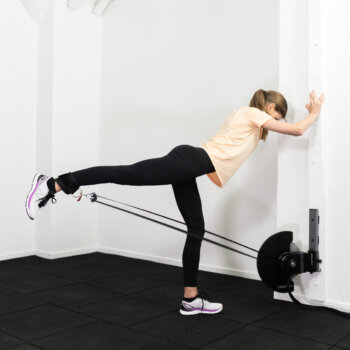
1) Standing with the working leg starting from the floor.
More glute involvement, less hamstring stretch. A great starting point to build up strength and mobility.

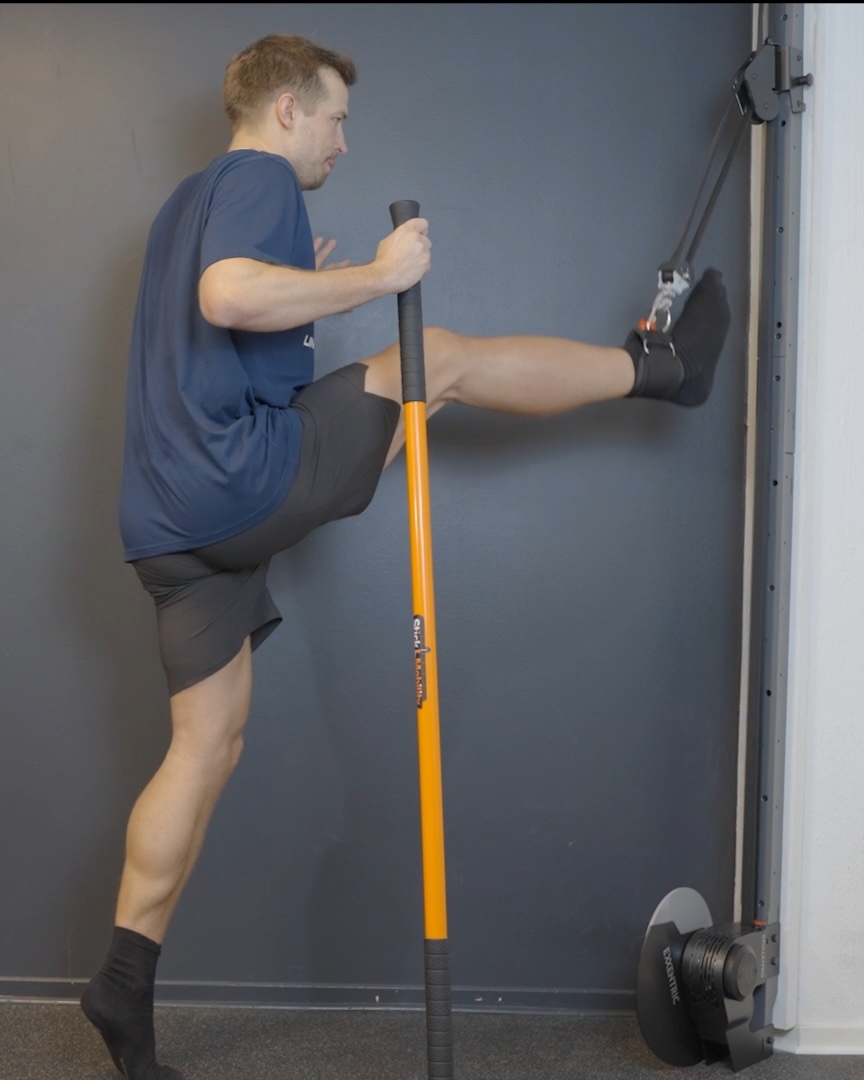
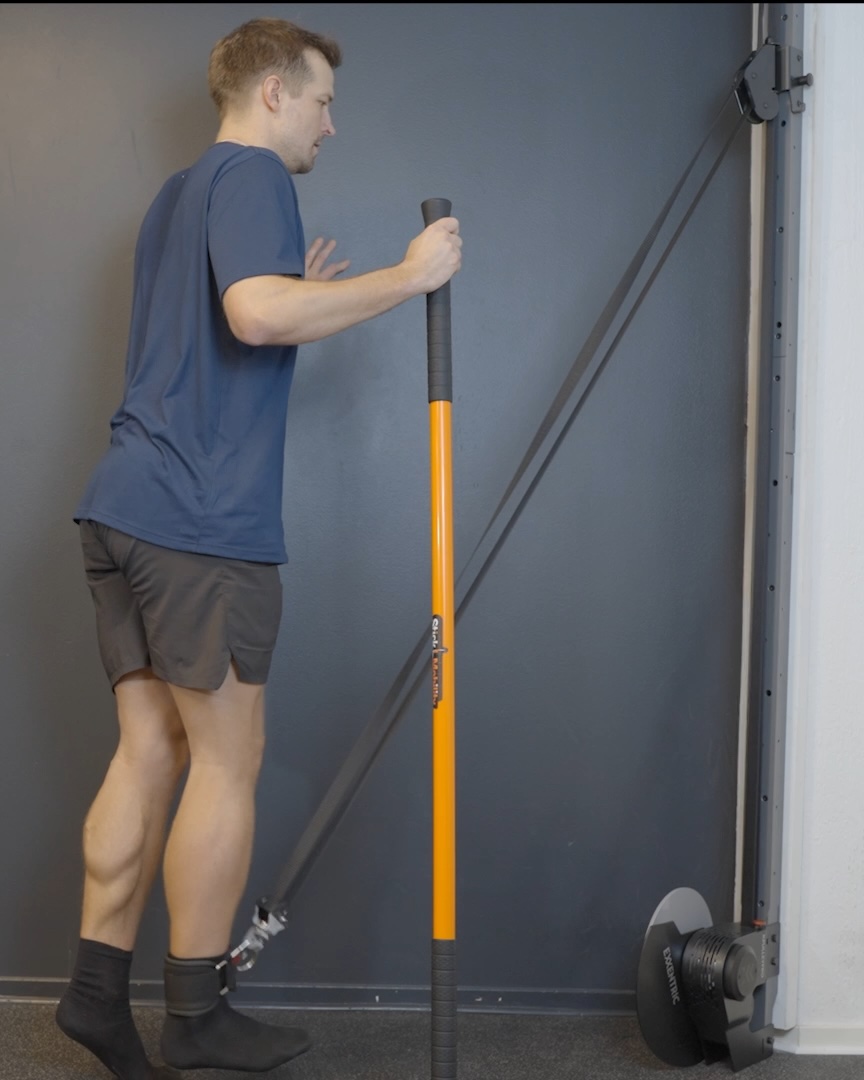
2) Standing with the working leg extended.
Maximal hamstring stretch, direct carryover to sprinting. Potentially better carry-over to athletics with a more “sport-specific” position.
3) Lying flat or with glutes slightly elevated.
Maximal hamstring stretch, more stable than standing. Potentially exert more force due to stability, easier to control direction of force.
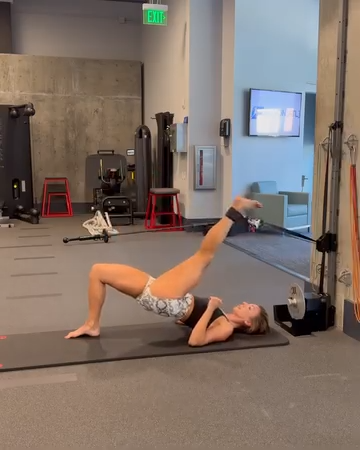
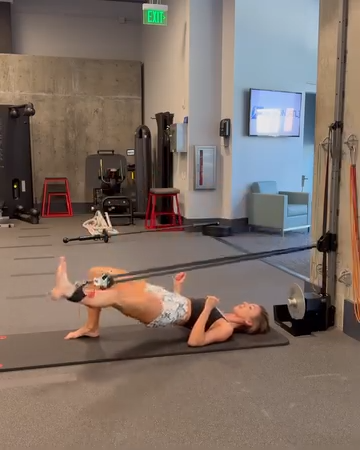
Choosing between 2) & 3) is largely a matter of personal preference. Try both and decide which one gives you the better stretch and lets you exert more force. Or simply train both.
How to program the flywheel hip extension
The best loading choice depends on the goal. Higher inertia generally suits maximal force-oriented work because the athlete has more resistance to overcome. Lower inertia allows faster movement and can be useful when the goal is velocity, power, or sharper intent.
For rehabilitation, the prescription should be individualized. The athlete’s injury history, current tolerance, stage of return to sport, and ability to control the eccentric phase all matter. A conservative progression usually beats rushing to aggressive loads too early.
Training prescription guide
| Training goal | Inertial load focus | Volume | Rest |
|---|---|---|---|
| Maximal strength and force production | Higher inertia, commonly above 0.07 kg·m2 | 3-4 sets of 6-8 reps | More than 120 seconds |
| Velocity and power development | Lower inertia, commonly below 0.05 kg·m2 | 3-4 sets of 6-10 reps | More than 120 seconds |
| Hypertrophy and muscular endurance | Individualized and adjusted to tolerance | 3-4 sets of 12-20 reps | Less than 60 seconds |
Where this fits in the training process
The flywheel hip extension is useful because it can live in more than one part of the performance continuum.
In rehab, it can provide a progressive eccentric stimulus once the athlete is ready for higher loading demands. In performance training, it can help maintain or develop hip-dominant hamstring qualities that support sprinting and acceleration. In team environments, it can be scaled across athletes because the exercise is simple to set up, repeat, and monitor.
Why this fits Exxentric systems
Exxentric systems are designed around a simple but powerful training logic: the user creates the load through intent, and then has to control the returning force. That makes the training stimulus responsive rather than fixed.
For a movement like the flywheel hip extension, that responsiveness matters. The athlete can work with high intent through hip extension, then receive an eccentric demand that reflects the energy they produced. This creates a natural link between force production and force absorption, which is central to both performance and injury resilience.
The kPulley is the most natural Exxentric reference for this specific exercise because it supports pulley-based hip-extension setups, unilateral loading, and versatile movement angles. For broader lower-body and posterior-chain programming, the kBox and SingleExx range can also support targeted strength development depending on the training context.
Movement examples
Use these examples as practical references for posterior-chain and hamstring-focused flywheel training with Exxentric equipment.
The bottom line
Traditional resistance training still belongs in a complete strength program. Heavy lifting, sprint exposure, Nordic hamstring work, isometrics, mobility, and progressive return-to-sport planning all have roles to play.
The flywheel hip extension adds something specific: hip-dominant hamstring loading with a strong eccentric demand and a practical setup that can be progressed over time. For athletes who need to sprint, accelerate, decelerate, and return from hamstring injury with confidence, that is a valuable tool.
Used well, FWHE is not just another hamstring exercise. It is a bridge between tissue capacity, eccentric strength, and the real movement demands of sport.
Key takeaways
- Hamstring strain injuries are closely tied to high-speed running demands, especially eccentric loading during sprinting.
- The biceps femoris long head is a key target because of its role in sprinting and its common involvement in hamstring injuries.
- The flywheel hip extension trains the hamstrings through hip extension rather than only knee flexion.
- Flywheel Training creates a responsive eccentric demand because the athlete must absorb the energy they produce.
- The kPulley offers a practical setup for unilateral FWHE work, asymmetry monitoring, rehab progressions, and performance programming.
- Programming should match the goal: higher inertia for force, lower inertia for velocity and power, and individualized progression for rehab.
Build hamstring strength that transfers to sport
Explore how Exxentric products can help coaches, clinicians, and athletes train force production, eccentric control, and sport-relevant resilience with practical flywheel systems.
Article referenceReferenced study: Perna, P., de Keijzer, K., Nutarelli, S., & Beato, M. (2026). The Flywheel Hip Extension: From Hamstring Rehabilitation to Performance. Strength & Conditioning Journal. Advance online publication.
DOI: 10.1519/SSC.0000000000000960
Most relevant points: The article frames the flywheel hip extension as a hip-dominant hamstring exercise that can support hypertrophy, fascicle-length adaptations, eccentric strength or power development, and progressive rehabilitation or performance training when prescribed appropriately.