



Strength Training When Motivation Is Low: Make the Session Smaller
A smaller session gives you another option: fewer decisions, familiar movements and a finish line you can see before the first repetition. Ten useful minutes still count.
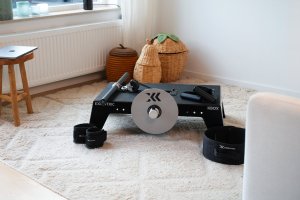
When the full workout becomes the obstacle
Low motivation does not always need a bigger motivational speech. Sometimes it needs a shorter list.
A normal session may ask you to choose exercises, set the load, remember the program, travel, warm up and decide whether today’s effort is good enough. When energy or concentration is limited, each step adds friction. The urge to compensate can make it worse: if the workout cannot be long, hard and progressive, why begin?
Decide what “enough” means before that argument starts. Choose a minimum session on a better day, save it and repeat it when the longer plan feels out of reach. Completing the minimum is the workout, not a failed version of something larger.
Pick the version that matches today
When motivation is low
Remove choices. Pick two movements you already know and complete one controlled set of each. Stop there if starting was the main job. Continue only if you genuinely want to.
After poor sleep
Keep the movements familiar and lower the demand. Acute sleep loss can reduce physical performance on average, although the response varies with the type and timing of sleep loss and the task being tested. This is a poor day for chasing records. Use controlled repetitions, leave several good repetitions available and reduce sets, range or effort if technique changes.
During a stressful period
Make the finish line visible. Set a timer for 6, 10 or 15 minutes and keep the exercise order fixed. A short session can preserve the routine without asking training to solve the source of the stress.
Why effort-responsive resistance changes the decision
With traditional weights, the external load is selected before the set and stays fixed until you change it. That is useful when a planned load is the point, but it can add another decision on a day when readiness is uncertain.
In Flywheel Training, you accelerate a rotating flywheel and control the energy that returns through the strap. Push harder and more energy returns. Use a more controlled effort and less energy returns. The same familiar movement and inertia can therefore accommodate different effort levels from repetition to repetition without unloading a bar or changing a weight stack.
That does not make every setup automatically safe or suitable. Exercise choice, inertia, range, technique and set volume still matter. The practical advantage is simpler: you can begin with controlled effort, see how the first repetitions feel and increase only when the day supports it.
Three short Flywheel Training sessions
Use movements you already perform confidently. Complete learning sessions before increasing intent or trying deliberate eccentric-overload methods.
6-minute restart
- kBox squat: 1 set of 6-8 controlled repetitions.
- kBox row: 1 set of 6-8 controlled repetitions.
- Rest briefly, then repeat only if the second round still fits the six-minute limit.
10-minute two-movement session
- kBox Romanian deadlift: 1-2 sets of 6-10 controlled repetitions.
- kBox press: 1-2 sets of 6-10 controlled repetitions.
- Finish each set with sound technique and several good repetitions available.
15-minute full-body session
- kBox squat: 2 sets of 6-10 controlled repetitions.
- kBox row: 2 sets of 6-10 controlled repetitions.
- kBox Romanian deadlift or press: 1-2 sets of 6-10 controlled repetitions.
The kBox Active System keeps these squat, hinge, row and press patterns on one compact platform. The Exxentric App can reduce another layer of decision-making by saving the session when concentration is available. An optional kMeter can record like-for-like sessions when tracking is useful, but a low-motivation workout does not need a score to count.
Strength Training Is Good for More Than Your Muscles
Exercise doesn’t just build strength. It can also support your mental health, improve mood, reduce symptoms of anxiety and depression, and contribute to better sleep.
Research increasingly highlights resistance training as an effective way to support mental well-being. A 2025 systematic review and meta-analysis involving 2,036 adults across 29 randomized trials found that resistance training reduced depressive symptoms compared with non-exercise control groups.
And here’s the encouraging part: you don’t need to chase a personal best every time you train to make exercise worthwhile.
Some days, you’ll feel ready to push yourself. Other days, after a stressful week, a poor night’s sleep, or simply feeling unmotivated, a shorter and more manageable session might be exactly what you need.
That’s where Flywheel Training offers a practical advantage. Because resistance responds to the effort you put into each repetition, you can adjust your output without constantly changing weights. You can train with greater intensity when you’re feeling strong or reduce your effort when you need a lighter session.
The important thing is building a routine that works with your life, not against it. Whether it’s six minutes or a full workout, making time to move is a positive step toward supporting both physical and mental well-being.
Make the next first repetition easier
A difficult week does not need to become a referendum on your discipline. Put the equipment where you can reach it, save one short session and decide the finish line in advance. When readiness improves, add effort, repetitions or a set. When it does not, complete the smaller plan and leave tomorrow an easier place to begin.
See how resistance can follow your effort
Explore how Flywheel Training works and see how inertia turns the effort you produce into resistance.
Research references
Resistance training and depression: Chang, Y., Wang, H., Zhang, X., Shan, S. and Liu, H. (2025). Resistance training for depression: a systematic review and meta-analysis of randomized controlled trials. Frontiers in Psychology, 16, 1655855. DOI: 10.3389/fpsyg.2025.1655855. The review included adults with diagnosed depression; heterogeneity was high and prescription analyses were exploratory.
Acute sleep loss and performance: Craven, J., et al. (2022). Effects of Acute Sleep Loss on Physical Performance: A Systematic and Meta-Analytical Review. Sports Medicine, 52(11), 2669-2690. DOI: 10.1007/s40279-022-01706-y. Effects varied by sleep-loss pattern, timing and performance task.
