


Eccentric Training. Make the Return Count.
Develop strength through both phases of the movement. Explore eccentric training and overload across kBox, kPulley and SingleExx.
Two Phases. One Complete Movement.
Concentric: create the movement
During the concentric phase, the working muscles shorten while producing force. Think of standing up from a squat, pulling a handle towards you or extending your knee on a leg extension machine.
Eccentric: control the return
During the eccentric phase, the working muscles produce force while lengthening. Think of lowering into a squat, controlling a handle as it returns or resisting knee flexion on a leg curl machine.
Eccentric training deliberately focuses on this lengthening phase. It can be part of a broader strength program, with the exercise, resistance and progression chosen to suit the person and their goal.
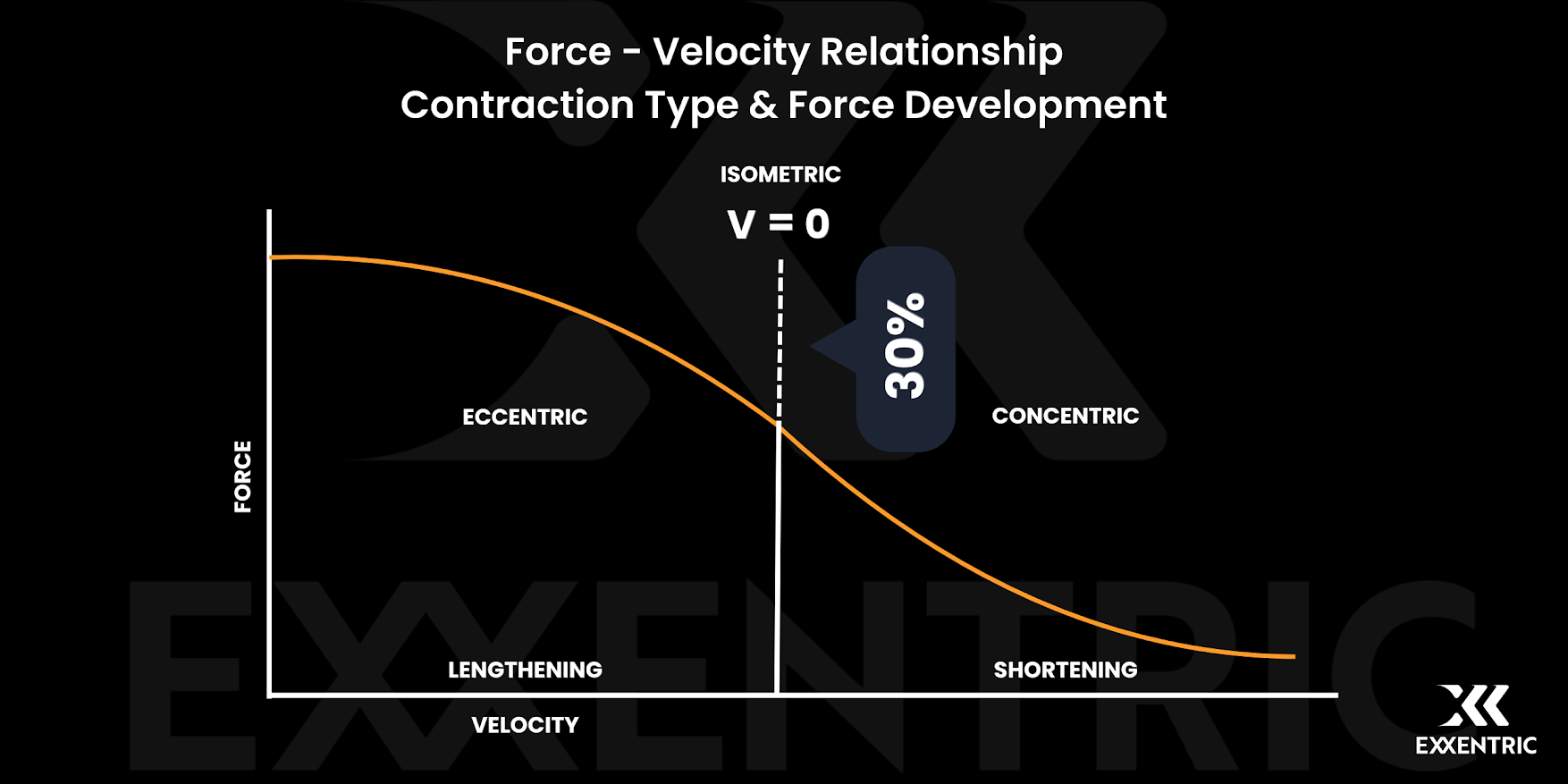
The force–velocity curve below illustrates why this phase deserves attention: muscles can generally produce more force while lengthening than while shortening. With conventional weights, the load you can lift concentrically usually limits what you lower eccentrically. Eccentric overload provides a way to place greater demands on that stronger lengthening phase.
Eccentric Training. What Does Overload Mean?
Eccentric training and eccentric overload are related, but they are not interchangeable. Every controlled return against resistance includes eccentric work. Overload requires an additional emphasis on the eccentric demand.
In flywheel training, eccentric overload is often assessed by comparing eccentric and concentric outputs, such as peak power. The result depends on the exercise, technique, inertia and the measurement used, such as peak or average power. Higher eccentric peak power does not, by itself, prove higher eccentric force or greater total work. [1, 2]
Accelerate. Then Absorb.
01. Put energy in
Your concentric effort accelerates the flywheel. Instead of lifting a fixed stack of weights, you create rotational energy through the movement.
02. Control the return
As the belt rewinds, you resist the returning movement and decelerate the flywheel. This loads the eccentric phase of the exercise.
03. Shape the demand
With appropriate technique, concentrating the braking into a shorter part of the return can increase the peak eccentric demand. Eccentric overload must be created through the way you perform the repetition; it is not guaranteed by the device alone.
Flywheel resistance adapts to the effort you put into each repetition, while the selected inertia influences the movement’s speed and force demands. Simply adding more flywheels does not guarantee more eccentric overload. [1, 2]
Practical overload with fewer handling challenges
Flywheel equipment makes eccentric overload practical without having to lift and lower a heavy barbell. Methods such as delayed eccentric braking can be performed without a partner lifting a supramaximal weight for you. This simplifies the setup and removes the need to catch or re-rack a loaded barbell, addressing some of the handling and safety challenges of conventional eccentric overload.
Resistance responds to your effort, while technique determines how you absorb the returning energy. These features support a controlled approach to eccentric loading, but safe use still depends on an appropriate setup, familiarisation and gradual progression. Some advanced overload methods require assistance; follow the guidance for your device and chosen exercise.
One Training Principle. Three Equipment Families.
Eccentric flywheel training extends across our range. Choose the movement pattern and training setting first, then the device that fits. The technique and setup should be specific to the exercise and equipment.

kBox: strength from a platform
Use the kBox for platform-based movements such as squats, deadlift patterns and broad full-body strength work. Accelerate through the concentric phase, then control the return as the flywheel rewinds.
The range: kBox Active, kBox Lite and kBox Pro.
From home training to professional facilities, the kBox provides a versatile foundation for eccentric training across a wide selection of exercises.
kPulley: strength at different angles
Bring eccentric training to horizontal pulling, pushing and rotational movements. The kPulley lets you work with different exercise heights and angles, making the return phase part of the training stimulus.
The range: kPulley Go, kPulley Go+ and kPulley Pro.
The Go and Go+ support portable setups, while the Pro is designed for professional installations with beam-based height adjustment. Choose the model and mounting setup that fit your environment.

SingleExx: focused leg training
The SingleExx family brings flywheel resistance to dedicated leg extension and leg curl movements. It provides a focused way to train the working muscles through both the concentric and eccentric phases.
LegExx: dedicated knee extensions for the quadriceps.
LegFlexx: dedicated leg curls for the hamstrings.
Designed for professional sports, performance and rehabilitation environments.
See Both Phases. Track Your Progress.
kMeter + Exxentric App
Use kMeter with the Exxentric App to review concentric and eccentric performance, follow your training history and compare sessions. Feedback helps you understand the effect of your effort and technique.
Compare like with like: use the same device, exercise, inertia and metric when evaluating changes. A peak-power comparison answers a different question from a mean-power or force comparison.
Feedback across the range
Built-in kMeter: kBox Lite, kBox Pro, kPulley Go+, kPulley Pro, LegExx and LegFlexx.
Optional kMeter: kBox Active and kPulley Go.
Build control before adding overload
Start by learning the movement and controlling the return. Establish a consistent range of motion and braking technique before progressing to more demanding overload methods.
Use device-specific guidance in the Exxentric App and work with a qualified coach when learning advanced techniques. In rehabilitation, exercise selection and progression should follow your clinician or physiotherapist’s guidance.
Eccentric Training. Why Mike Young Chooses kBox.
At Athletik-Konferenz 2018, Mike Young explains why the kBox is his preferred method for eccentric-focused training and discusses its practical application.
Research & Further Reading
1. Muñoz-López A., Nakamura F.Y., Beato M. (2023). Eccentric overload differences between loads and training variables on flywheel training. Biology of Sport, 40(4), 1151–1158.
2. Martinez-Aranda L.M., Fernandez-Gonzalo R. (2017). Effects of Inertial Setting on Power, Force, Work, and Eccentric Overload During Flywheel Resistance Exercise in Women and Men. Journal of Strength and Conditioning Research, 31(6), 1653–1661.
Explore the Science Behind Flywheel Training
Learn About Eccentric Overload Methods