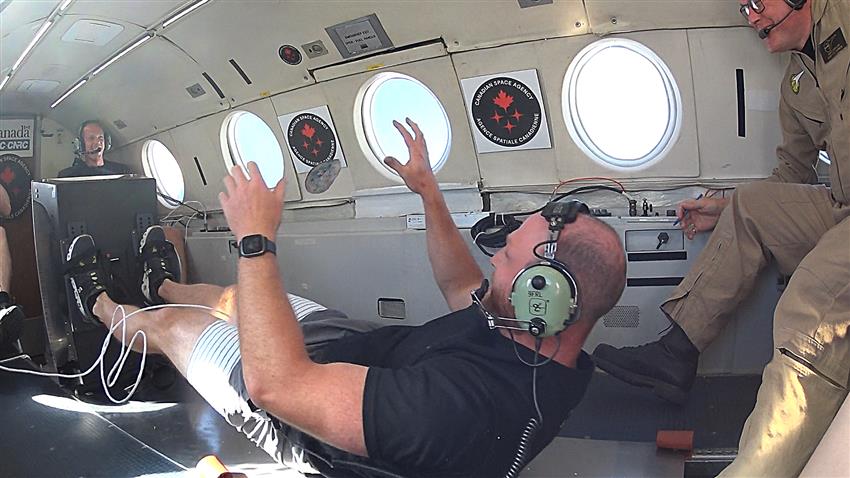
Astronauts can lose up to 20% of their muscle mass in just weeks of being in zero-gravity. The problem is not motivation, it is physics. Exxentric CEO and Co Founder Fredrik Correa, , explores how a training concept born for space travel has become one of the most effective methods on Earth.
How Solving a “Space” Problem changed Performance Training
Flywheel Training did not begin in the gym. It began in space.
The concept that sparked Exxentric was originally developed to solve a critical problem, how do you maintain strength in an environment without gravity. Early research connected to space agencies and human performance in orbit laid the foundation for what would later become modern Flywheel Training. Read more HERE.
Exxentric took this concept and transformed it into practical, scalable Flywheel Systems like the kBox, bringing space proven training methods to athletes, clinics, and everyday users.
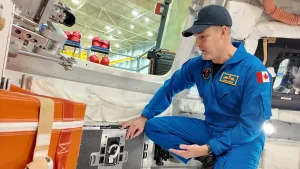
And now, with Artemis II, flywheel training is going back to its origins, closing the loop between innovation and real world application. In preparation for the mission, our kBox was used extensively by the Canadian Space Agency to test and develop the protocol currently being used by the Artemis crew.
Why Traditional Strength Training in Space Fails
Training in space is not just difficult. It fundamentally relies on different laws of physics.
Without gravity, traditional weights lose their effect. Your body, a barbell, or a dumbbell all have mass, but no weight. That means no meaningful resistance.
This leads to rapid muscle atrophy and significant bone density loss. Studies consistently show that without proper countermeasures, astronauts can lose meaningful strength and skeletal integrity in a matter of days.
There are also strict constraints. Spacecrafts have limited room. Equipment must be compact, efficient, and safe. All while being usable, serviceable, and reliable throughout the course of a full mission.
For decades, this created a challenge. How do you deliver effective strength training in a minimal footprint, without relying on gravity?
The Solution: Removing Gravity from the Equation
Flywheel Training solves this problem by removing gravity from the equation, replacing it with the unaffected inertia of a flywheel.
Instead of relying on weight, a Flywheel System generates resistance through inertia. You create force by spinning a flywheel, subsequently absorbing that same energy on the way back down.
This creates a continuous loop of effort. You drive concentrically, then control the return through the braking phase.
Because resistance is created by user input, it adapts instantly to your level output. Push harder, and the system responds. The faster you spin, the more the flywheel’s inertia resists, leading to what we call variable or auto-adjusting resistance.
Research shows that this type of training enables high levels of muscle activation and can facilitate greater eccentric loading when applied with controlled deceleration, as demonstrated in studies like Norrbrand 2010 and Maroto Izquierdo 2019.
In short, Flywheel Training delivers high stimulus with minimal foot print, making it ideal for environments where traditional loading is not possible.
The vacuum-based equipment currently aboard the ISS weighs a combined 1,800 kg and takes up nearly 24 cubic meters. Source
The flywheel unit being used by the Artemis crew weighs just 14 kg and is the size of a briefcase. In space or on Earth, a flywheel system offers unmatched results per square inch.
kBox vs Artemis II System
The Flywheel Systems being used in space and on Earth share the same foundation.
Both are drive belt-based systems driven by rotational inertia. But they are built for different environments.
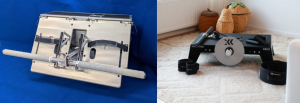
The Orion flywheel device used in space is ultra compact. It is designed for safety, simplicity, and strict space constraints. Resistance capacity is limited, and training is focused on essential movements.
The kBox, developed by Exxentric, represents a more performance-focused implementation of the same principle. It offers a wider range of inertia, a broader exercise library, and the ability to reach higher performance outputs. The kBox also offers a greater focus on eccentric overload.
The key takeaway is simple. The NASA design uses a minimal version of the same concept. The kBox takes advantage of greater training freedom to deliver the same base principle but in a more user-friendly, higher-performing, versatile package for the earth-bound trainee.
Train Like an Astronaut. Without Leaving Earth
You do not need zero gravity to benefit from Flywheel Training.
With an Exxentric Flywheel System like the kBox, you can apply the same principles used in space missions directly to your own training.
Training like an astronaut means focusing on the big, high-yield movements like hinges, squats, rows, and presses while maximizing foot-print, training efficiency, and versatility.
The key takeaways from the Artemis II protocol:
Versatility
The variable resistance of a flywheel unit means that the same device can be used for cardiovascular training like rowing as well as heavy-duty strength training like deadlifts, squats, rows.
This is something you can actively implement into your own training, using different inertia levels for a broader range of training outcomes. Think of a relatively low inertia level as a rowing machine or an air-bike, providing variable resistance for cardio and conditioning training. For example, use an S flywheel for cardio-based rowing or high-pulls, use an M flywheel to do high-rep burn-out squats for conditioning, and use multiple L or XLs for ultra-heavy squats and deadlifts. All on the same device, just like the astronauts.
All-in-One
A flywheel device, such as our kBox, offers 70+ exercises for the full body. Rows, hinges, squats, curls, high pulls, presses, extensions, and more can all be performed on one universal piece of equipment.
While in space this ensures a maximally effective preservation of muscle and bone density, for the earth-bound trainee this means an ability to perform maximal potency full-body training on a single piece of equipment.
Want to train like an Astronaut? Just now, we’re giving you an additional 10% OFF the kBox Active System. Offering everything the crew of the Artemis II has at their disposal and more.
Train with the same principles used on Artemis II. This all-in-one flywheel system delivers gravity-independent resistance, enabling full-body strength training in a compact, portable setup.
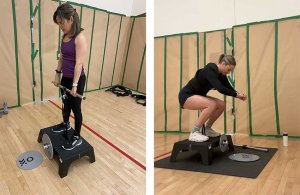
What to Add
For the sake of efficiency, the space mission protocol doesn’t put a great focus on eccentric overload. You, as an earth-bound user, absolutely should. The kBox offers seamless access to eccentric overload which has been scientifically proven to enhance strength and muscle gain.
Read More HERE
Closing the Loop: From Orbit Back to Earth
When NASA chooses a training method, it is not based on trends. It is based on very specific outcomes and benefits.
For the Artemis II mission, NASA turned to Flywheel Training as a highly efficient and versatile solution to maintain muscle mass and bone density in zero gravity. The same principles were tested using the Exxentric kBox in collaboration with the Canadian Space Agency.
This validates what athletes and coaches already know.
Flywheel Training just works.
And it works not just as an alternative, but as a proven method for high performance environments, both in space and here on Earth. NASA approved.